
CA Chooses Prevention vs Punishment for E-bikers

Electric bicycle with helmet and reflective vest on a bike path

The average e-bikes can travel up to 28 mph. However, drivers may have little or none of the training required to drive vehicles that can obtain that speed.  Young e-bike riders suffer traumatic brain injuries at nearly twice the rate of traditional cyclists, and fewer than half of hospitalized riders wore helmets. To address this, California has passed a law that chooses prevention over punishment, seemingly similar to the law requiring that teenagers take Driver’s Education classes.

On August 27, 2026, Governor Gavin Newsom signed Assembly Bill 1569, directing the California Department of Education, with the California Highway Patrol, to build a standardized e-bike safety and training program for students in grades 7 through 12 by March 2028. Sponsored by Assemblymembers Laurie Davies and Phillip Chen, the Pupil safety: electric bicycle: safety and training program bill unanimously passed the Assembly 77–0.

California’s attempt to address the risks of e-bikes, brain injury and otherwise, through the classroom, contrasts the approach of eleven other states that currently require licenses for their operation: Alabama, Alaska, Connecticut, Hawaii, Louisiana, Massachusetts, Missouri, West Virginia, New Mexico, North Dakota, and New Jersey, the strictest. It will be interesting to compare the efficacy of these approaches and to see if some sort of a combination of law and education is needed.
NE Joins States to Promote Veteran Brain Injury Bill – Congress Has Run Out of Excuses

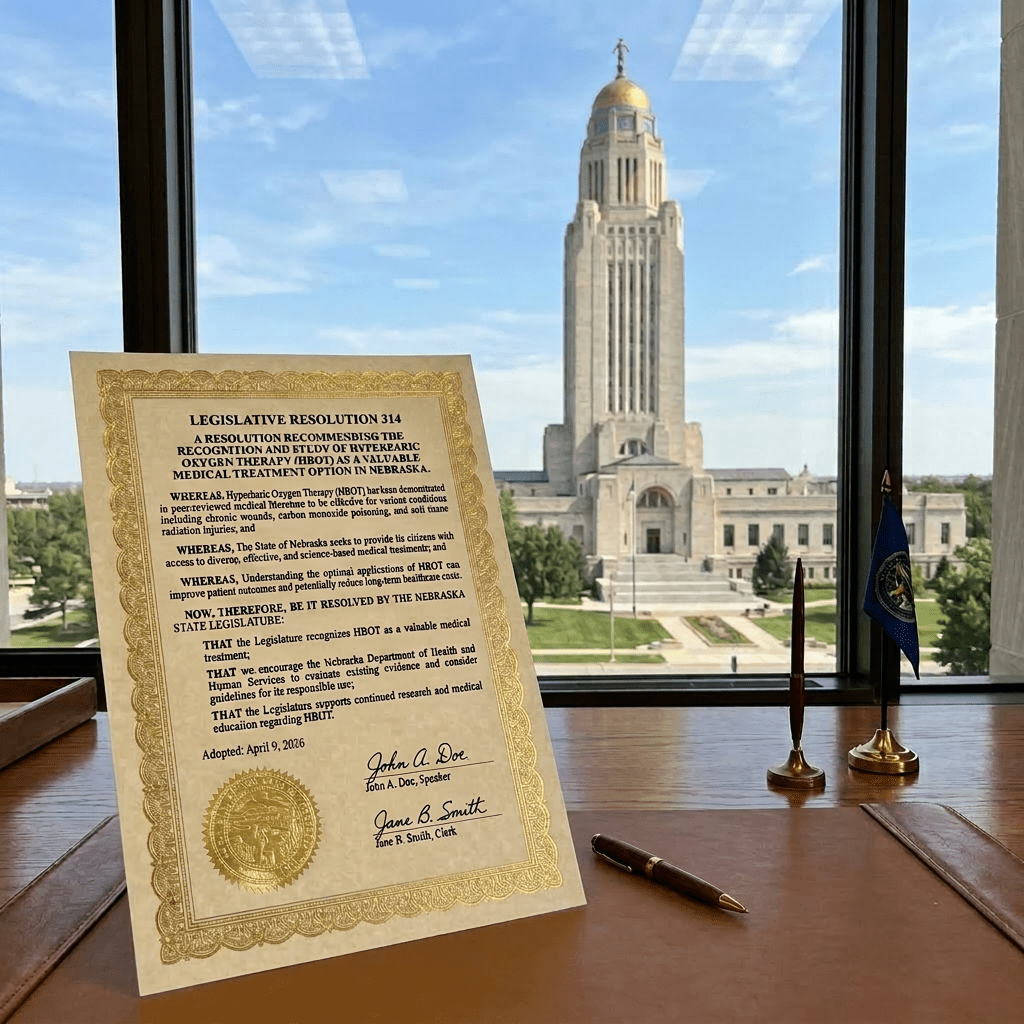
Legislative Resolution 314 on hyperbaric oxygen therapy with Nebraska Capitol building in background

On April 9, 2026, Nebraska’s Legislature passed Legislative Resolution 293 in a 43-0 vote, making it the 14th state – alongside Oklahoma, Texas, Indiana, Kentucky, Arizona, Florida, North Carolina, Wyoming, Maryland, Virginia, North Dakota, Tennessee and Missouri – to formally urge Congress to expand treatment access for veterans suffering from traumatic brain injury and post-traumatic stress disorder, one of the most pressing issues facing American veterans.

Introduced by Nebraska State Senator Kathleen Kauth, the resolution, “[urges] the United States Congress to swiftly enact legislation to provide for veterans’ access to treatments for traumatic brain injury (TBI) and post-traumatic stress disorder (PTSD).”

In particular, states’ resolutions seek to encourage Congress to move forward on hyperbaric oxygen therapy. “A 4-week course of HBOT may alleviate depressive symptoms in PTSD patients, an effect associated with increased serum BDNF and β-NGF levels,” according to a 2026 study, available to view on the NLM database. The United States loses more than 17 veterans per day to suicide, with TBI and PTSD among the leading contributing factors.

Now that 14 states are aligned behind this legislation, the pressure on Congress to act is mounting.