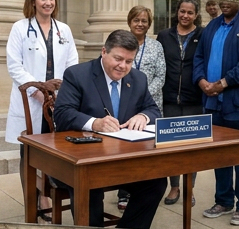
Thirty years ago, Congress first passed the Traumatic Brain Injury Act, “to amend the Public Health Service Act to provide for the conduct of expanded studies and the establishment of innovative programs with respect to traumatic brain injury.” The federal program it created has now been without authorization since the end of fiscal year 2024.* On September 29, the Senate passed S.5600, Dennis John Benigno Traumatic Brain Injury Program Reauthorization Act of 2026, by voice vote the same day it was introduced, to possibly fix this financing lapse.

The bill is sponsored by Sen. Alan Armstrong (OK), who was appointed to the Senate following the resignation of Markwayne Mullin, who now serves as the head of the Department of Homeland Security. S.5600 is very similar to Mullin-sponsored S.2898 in content and title, although with date adjustments. However, Dennis John Benigno Traumatic Brain Injury Program Reauthorization Act of 2025 never got past the Senate Health committee (HELP), to which it was referred to on September 18, 2025. (The last action on S.2898 was a star print on October 8, 2025.)
Co-sponsors of S.5600 include Senator Andy Kim (NJ), friend and colleague of Representative Bill Pascrell, Jr. (NJ), a fervent advocate for those with brain injury. The federal traumatic brain injury program is named in honor of a teen from Pascrell’s northern New Jersey district who prompted his advocacy. The 2026 bill’s other cosponsors include John Cornyn (TX) and Catherine Cortez Masto (NV).
S.5600 renews CDC prevention and surveillance work and two Administration for Community Living grant programs through fiscal 2031. It also names the CDC surveillance program after Pascrell, who passed away in 2024. The Bill Pascrell, Jr., National Program for Traumatic Brain Injury Surveillance and Registries handles nationwide tracking, research, and support infrastructure. New provisions add tribal eligibility, track high-risk groups such as public safety officers and domestic-violence survivors, and order a study of long-term effects, including dementia.
The current hurdle is the House, which passed its own version, H.R.1493, in July. That bill runs only through FY2030, so the chambers must reconcile their differences.
Pascrell’s successor, Representative Nellie Pou, acknowledges the importance: “We must get a TBI renewal across the finish line this year.”
*Without federal authorization, Congress can and has still funded programs. However, without a law guarantee of financial funding, it must be newly argued each fiscal year.