NE Joins States to Promote Veteran Brain Injury Bill – Congress Has Run Out of Excuses

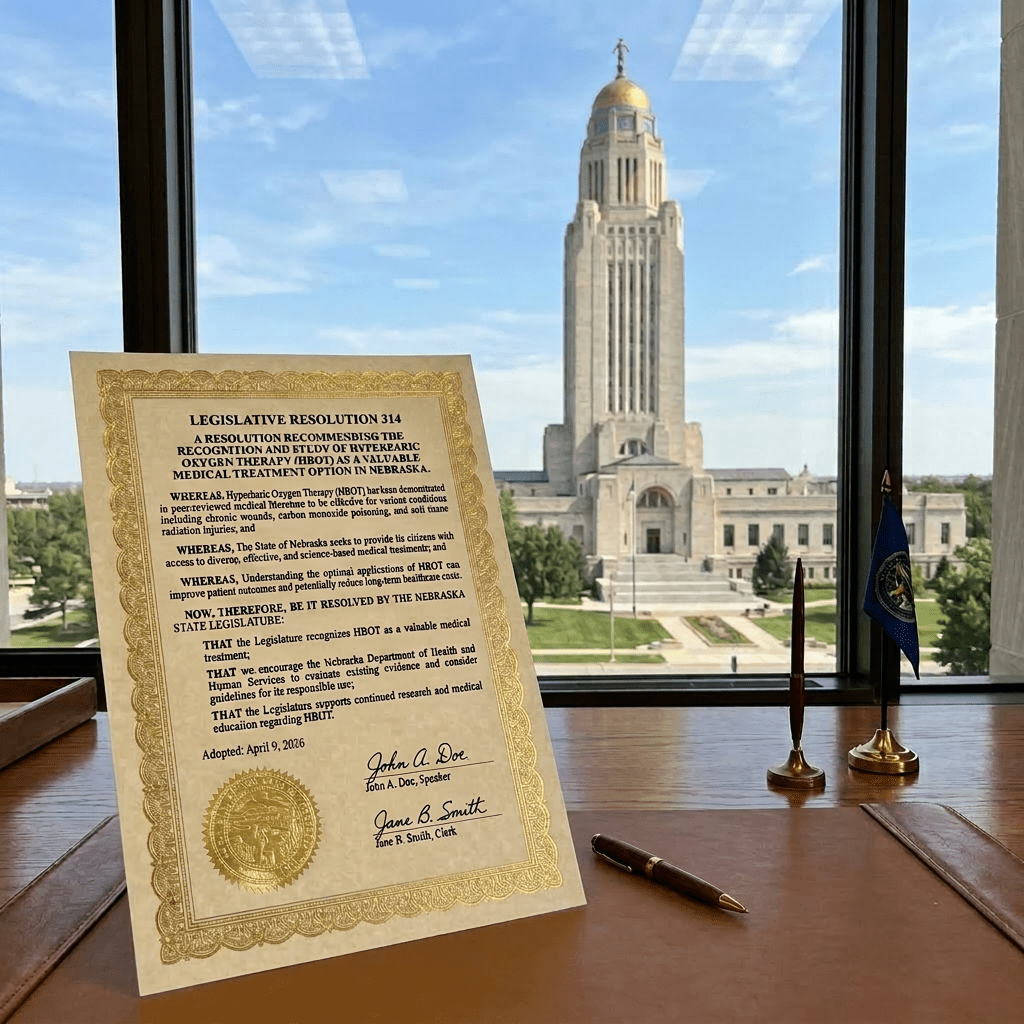
Legislative Resolution 314 on hyperbaric oxygen therapy with Nebraska Capitol building in background

On April 9, 2026, Nebraska’s Legislature passed Legislative Resolution 293 in a 43-0 vote, making it the 14th state – alongside Oklahoma, Texas, Indiana, Kentucky, Arizona, Florida, North Carolina, Wyoming, Maryland, Virginia, North Dakota, Tennessee and Missouri – to formally urge Congress to expand treatment access for veterans suffering from traumatic brain injury and post-traumatic stress disorder, one of the most pressing issues facing American veterans.

Introduced by Nebraska State Senator Kathleen Kauth, the resolution, “[urges] the United States Congress to swiftly enact legislation to provide for veterans’ access to treatments for traumatic brain injury (TBI) and post-traumatic stress disorder (PTSD).”

In particular, states’ resolutions seek to encourage Congress to move forward on hyperbaric oxygen therapy. “A 4-week course of HBOT may alleviate depressive symptoms in PTSD patients, an effect associated with increased serum BDNF and β-NGF levels,” according to a 2026 study, available to view on the NLM database. The United States loses more than 17 veterans per day to suicide, with TBI and PTSD among the leading contributing factors.

Now that 14 states are aligned behind this legislation, the pressure on Congress to act is mounting.

MO Brings Oxygen into TBI Recovery

Missouri has demonstrated remarkable commitment to our veterans with the ratification of SB 664 on July 14, 2025.  The “Veterans Traumatic Brain Injury Treatment and Recovery Act,” was passed with overwhelming support of 33-0 in the Senate and 156-1 in the House. Governor Mike Kehoe signed this groundbreaking legislation on Monday, establishing a fund to reimburse Hyperbaric Oxygen Therapy (HBOT) facilities treating veterans with TBI or PTSD, recognizing the treatment’s potential to combat veteran suicide and opioid addiction. The initiative represents a projected investment exceeding $5 million annually, underscoring the state’s confidence in this therapeutic approach.

HBOT works by delivering 100% oxygen in pressurized chambers at 1.4-3 times normal atmospheric pressure, dramatically increasing oxygen delivery to damaged brain tissues. Advocates report that this treatment “stimulates brain wound healing and can reverse soft tissue and neurocognitive damage” without requiring invasive surgery or pharmaceutical interventions. Patients can “experience recovery of cognitive and neurological functioning” through this non-invasive approach.

Clinical research has yielded encouraging results across multiple studies. For moderate-to-severe TBI cases, several high-quality studies demonstrated statistically significant improvements in consciousness recovery compared to standard care alone. Research has consistently shown better Glasgow Outcome Scale scores and reduced mortality rates in HBOT treatment groups. A comprehensive 2016 review highlighted that “most successes occurred within hours after TBI,” emphasizing the importance of early intervention. Particularly compelling evidence comes from pediatric research, where a study of 56 children with severe TBI found that HBOT “significantly improved quality of life and reduced complications” compared to control groups. Additional research involving 56 patients showed “significant improvement in symptoms and increased brain activity” measurable through SPECT (Single Photon Emission Computed Tomography) brain imaging.

The treatment maintains a generally acceptable safety profile, with most side effects being minor and temporary, including ear discomfort, headaches, and fatigue. Serious adverse events remain rare when HBOT is properly administered. This positive safety record, combined with growing clinical evidence and strong legislative support, has led some VA facilities to begin offering HBOT treatment to veterans, representing an important step toward broader acceptance of this promising therapeutic intervention.