NE Joins States to Promote Veteran Brain Injury Bill – Congress Has Run Out of Excuses

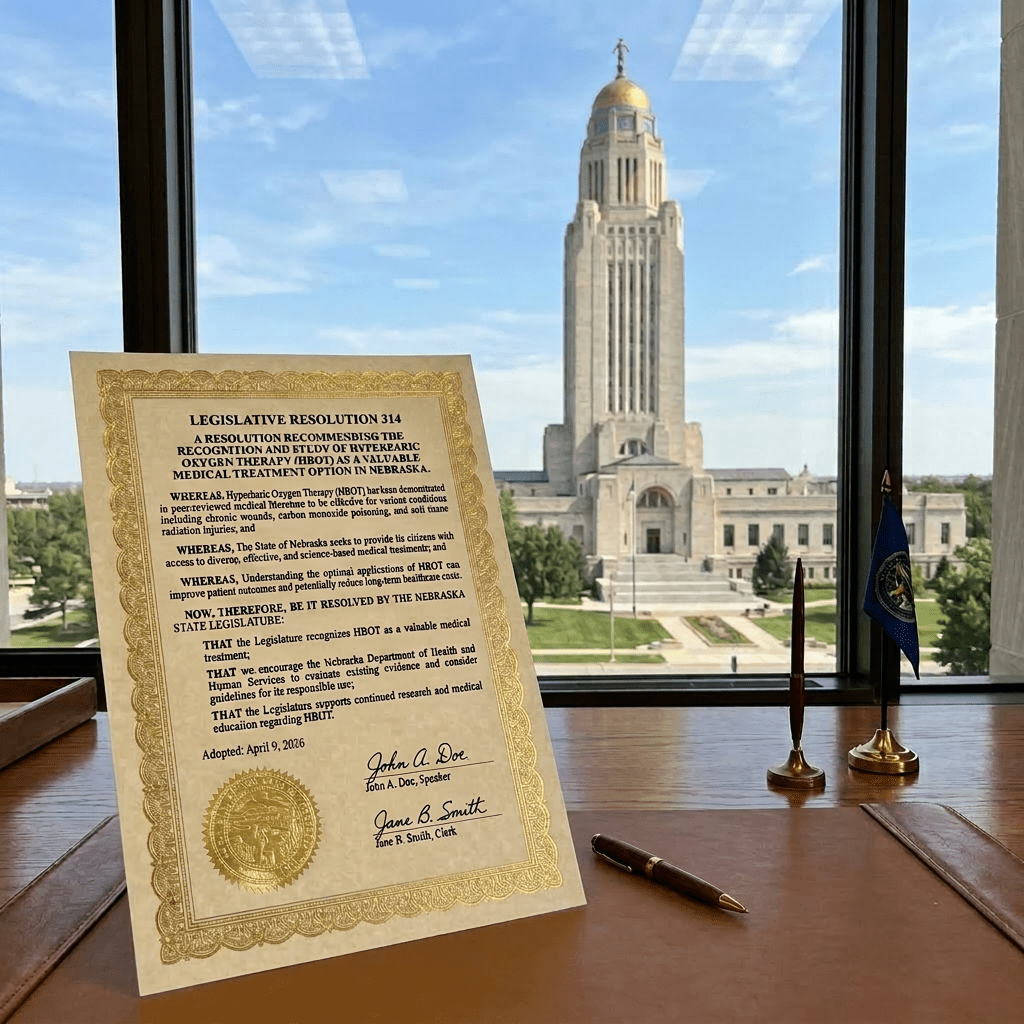
Legislative Resolution 314 on hyperbaric oxygen therapy with Nebraska Capitol building in background

On April 9, 2026, Nebraska’s Legislature passed Legislative Resolution 293 in a 43-0 vote, making it the 14th state – alongside Oklahoma, Texas, Indiana, Kentucky, Arizona, Florida, North Carolina, Wyoming, Maryland, Virginia, North Dakota, Tennessee and Missouri – to formally urge Congress to expand treatment access for veterans suffering from traumatic brain injury and post-traumatic stress disorder, one of the most pressing issues facing American veterans.

Introduced by Nebraska State Senator Kathleen Kauth, the resolution, “[urges] the United States Congress to swiftly enact legislation to provide for veterans’ access to treatments for traumatic brain injury (TBI) and post-traumatic stress disorder (PTSD).”

In particular, states’ resolutions seek to encourage Congress to move forward on hyperbaric oxygen therapy. “A 4-week course of HBOT may alleviate depressive symptoms in PTSD patients, an effect associated with increased serum BDNF and β-NGF levels,” according to a 2026 study, available to view on the NLM database. The United States loses more than 17 veterans per day to suicide, with TBI and PTSD among the leading contributing factors.

Now that 14 states are aligned behind this legislation, the pressure on Congress to act is mounting.

Cursive Writing Benefits to Students & the Brain Injured

Cursive writing functions as a complex motor skill that can remarkably persist even when brain injury patients lose explicit memory of how to perform it. This surprising phenomenon occurs because cursive engages procedural memory systems stored in the basal ganglia and cerebellum, which often remain intact when other cognitive functions are impaired. Recent NIH-funded research demonstrates that “attempting to write each letter produces a unique pattern of activity in the brain,” as Stanford’s Dr. Frank Willett explained in a 2025 study. A comprehensive 2025 analysis published by the NIH found that cursive writing creates enhanced connectivity across motor, visual, and memory regions.

For brain injury survivors, studies suggest cursive practice offers superior rehabilitation benefits. Unlike typing, which “relies on repetitive finger movements,” cursive engages “fine motor coordination and smooth transitions between letters,” activating broader neural networks crucial for recovery, according to recent university research. The continuous motor control required for cursive helps rebuild damaged neural pathways and enhances fine motor skills essential for rehabilitation.

Currently, many states have been dropping cursive instruction as a curriculum requirement, but recent neurological evidence has prompted policy reversals. New Jersey State Senator Angela McKnight recently advanced legislation requiring cursive proficiency by fifth grade, stating: “We’re doing our children a disservice by not teaching them a vital skill they will need for the rest of their lives.” California, Kentucky, and New Hampshire have reinstated requirements after recognizing cursive’s cognitive benefits. This resurgence reflects growing understanding that cursive writing enhances memory retention, motor control, and neural integration—benefits particularly valuable for cognitive development and including for those with a brain injury.