NE Joins States to Promote Veteran Brain Injury Bill – Congress Has Run Out of Excuses

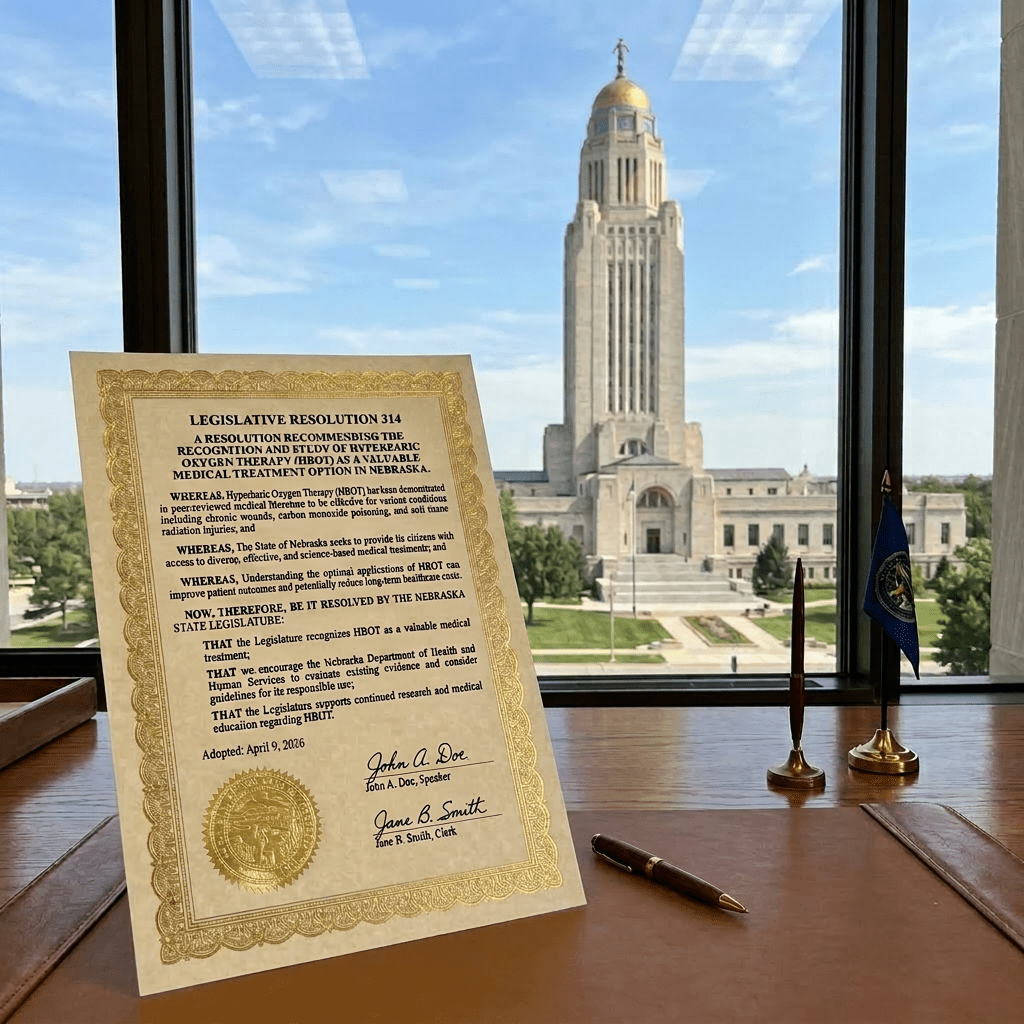
Legislative Resolution 314 on hyperbaric oxygen therapy with Nebraska Capitol building in background

On April 9, 2026, Nebraska’s Legislature passed Legislative Resolution 293 in a 43-0 vote, making it the 14th state – alongside Oklahoma, Texas, Indiana, Kentucky, Arizona, Florida, North Carolina, Wyoming, Maryland, Virginia, North Dakota, Tennessee and Missouri – to formally urge Congress to expand treatment access for veterans suffering from traumatic brain injury and post-traumatic stress disorder, one of the most pressing issues facing American veterans.

Introduced by Nebraska State Senator Kathleen Kauth, the resolution, “[urges] the United States Congress to swiftly enact legislation to provide for veterans’ access to treatments for traumatic brain injury (TBI) and post-traumatic stress disorder (PTSD).”

In particular, states’ resolutions seek to encourage Congress to move forward on hyperbaric oxygen therapy. “A 4-week course of HBOT may alleviate depressive symptoms in PTSD patients, an effect associated with increased serum BDNF and β-NGF levels,” according to a 2026 study, available to view on the NLM database. The United States loses more than 17 veterans per day to suicide, with TBI and PTSD among the leading contributing factors.

Now that 14 states are aligned behind this legislation, the pressure on Congress to act is mounting.


Spring Forward, Fall Down: Neurological Effect of Time Change

Every March, we lose an hour of sleep, or we gain an hour of sunlight, depending on your perspective. For TBI survivors, this forced clock shift has medically been proven to be particularly cruel. Up to 70% of survivors already struggle with disrupted sleep and circadian rhythms. Unfortunately, that is the same biological clock that drives the neural repair process itself.

The twist, though, is that the extra daylight we are about to gain can actually help injured brains heal. Powered by sunlight, studies have shown that Vitamin D is typically low in brain injury patients, particularly at rehab admission, and deficiency is linked to worse survival. While adding a Vitamin D supplement into your daily pill regiment is good, natural Vitamin D absorption is always best.   

While it may seem a biannual norm, it wasn’t until March 19, 1918 that time became a legislative concern in the United States. President Woodrow Wilson signed the Standard Time Act of 1918, also known as the Calder Act, “to save daylight and to provide standard time, for the United States.”. (On January 20, 1942, President Roosevelt established War Time, which halted the time shift from 1942 – 1945.)

More recently, opposition to time change has increased and a large minority of Americans say that they do not want to keep switching their clocks. In Congress, S.29, Sunshine Protection Act of 2025, sponsored by current Secretary of State, former Florida Senator, Marco Rubio and Rep. Vern Buchanan (FL) would have made Daylight Savings Time permanent. This Congressional year, Rep. Greg Steube (FL) introduced H.R. 7378, Daylight Act of 2026, that would permanently move U.S. clocks forward by 30 minutes and eliminate the biannual time change. As of March 4, 2026, this Act is in the House.

*British Columbia will permanently adopt year-round daylight saving time in 2026, with the final “spring forward” occurring on Sunday, March 8, 2026. It may be useful to observe how this change, or lack there of, functions in another country that has same time zones before passing legislation.

Texas Governor Declares Disaster to Combat Screwworm Threat

Governor Greg Abbott issued a statewide disaster declaration Thursday, January 29th to prevent a certain species of screwworm fly from entering Texas, mobilizing state resources against a parasite. “Although… not yet present in Texas or the U.S., its northward spread from Mexico toward the U.S. southern border poses a serious threat,” Abbott stated.

Cochliomyia hominivorax, also called Coquerel or New World screwworms, are parasites endemic in South America and the Caribbean. Not new to America, the U.S. was declared free of the parasite in 1966 by the US Department of Agriculture, after successful eradication efforts. A small outbreak occurred in the Florida Keys in 2017.

According to the US Embassy in Costa Rica, “screwworm flies predominantly affect cattle, but frequently affect dogs… and occasionally affect humans.” Experts warn that maggots can burrow into vulnerable tissue like the brain, causing sepsis. Sepsis can cause severe brain damage through systemic inflammation, disrupting the blood-brain barrier (BBB), oxygen deprivation, and neuroinflammation, leading to acute issues like delirium and coma, and long-term cognitive deficits. The Embassy further discusses the story of a 15-year-old girl developed intense headaches after 45 larvae infested a scalp wound, demonstrating risks to children and representing the first human death since the 1990s.

Protection requires cleaning and covering all wounds, wearing long-sleeved clothing, and using EPA-registered insect repellents.