UC Leads National Study of Support for Brain Injury Caregivers

The NIH announced on October 6, 2026, that they have provided a R01 grant of $2.5 million to University of Cincinnati researchers. Building on the positive results of an earlier and smaller study, this five-year study is instead a larger national trial of a wellness program for families caring for loved ones with traumatic brain injuries.
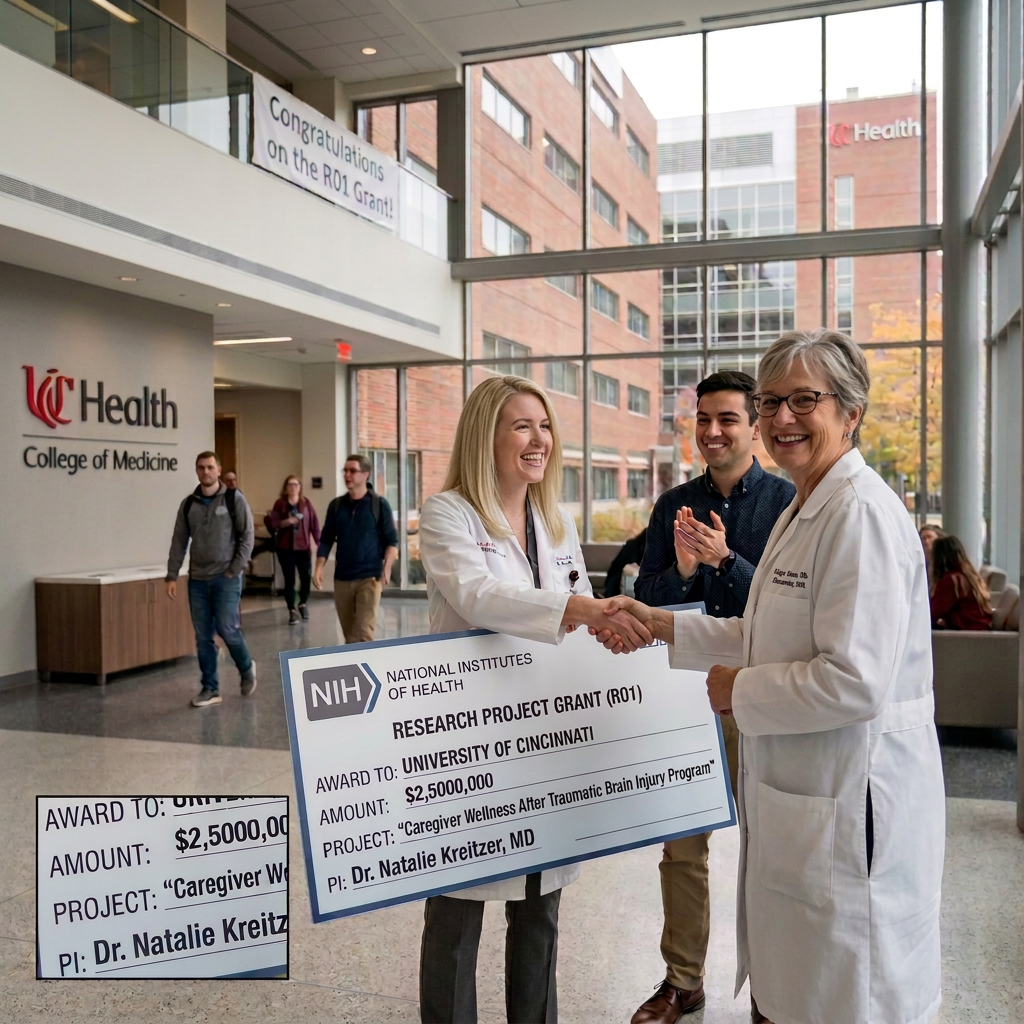
Researchers present a $2,450,000 NIH research grant check at UC Health College of Medicine; banner reads “Congratulations on the R01 Grant!” and check names University of Cincinnati, Caregiver Wellness After Traumatic Brain Injury Program, and Dr. Natalie Kreitzer, MD.

Led by Natalie Kreitzer, MD, UC, the Caregiver Wellness After Traumatic Brain Injury Program tests a web- and phone-based program. Caregivers will be guided through personal stress and distress, coping, patient outcomes and cost following a loved one’s traumatic brain injury, in addition to other related topics, such as medical leave, the move from the ICU to rehab, and preparing the home. Involving input not only from UC, but also The Ohio State University, Washington University in St. Louis and the University of Washington, the goal is for 354 patient-caregiver pairs to enroll, with a set start date in early 2027.

A Dangerous TBI Two-Way Street

A traumatic brain injury doesn’t just raise your risk of later neurological disorders; preexisting neurological disorders may raise the risk of brain injury, concludes a recent 2026 study from the San Francisco Veterans Affairs Health Care System.

Diagram showing circular relationship between brain injury and epilepsy with arrows indicating feedback loop and mutual exacerbation of seizures and brain damage

Published June 17, 2026. in the journal Neurology, the Department of Defense-supported study tracked more than 55,000 older veterans. Scientists found that traumatic brain injury was tied to higher rates of stroke, dementia, epilepsy, and Parkinson’s disease both before and after the injury. “Our findings raise the possibility that… [pre-existing brain diseases] are themselves risk factors for TBI in older people,” said study author Carrie Peltz, PhD, of the San Francisco Veterans Affairs Health Care System.

In the year before a TBI, older veterans were about three times more likely to have been diagnosed with stroke, dementia, or Parkinson’s and more than four times more likely to have epilepsy. After a TBI, they were roughly twice as likely to have a stroke or epilepsy. This results greatly build on an Oxford Academic, PubMed-accessible, 2025 study that found, “Among those with TBI, patients with pre-injury dementia had particularly high chronic mortality.” While causality has not firmly been medically defined, the study’s results are clear.