“From Invisible Injury to Precision Medicine” with Metabolism

The mildest brain injuries, the most common, leave no trace on CT or MRI scans. New research says the answer to this conundrum may lie in metabolism, how the injured brain burns fuel.
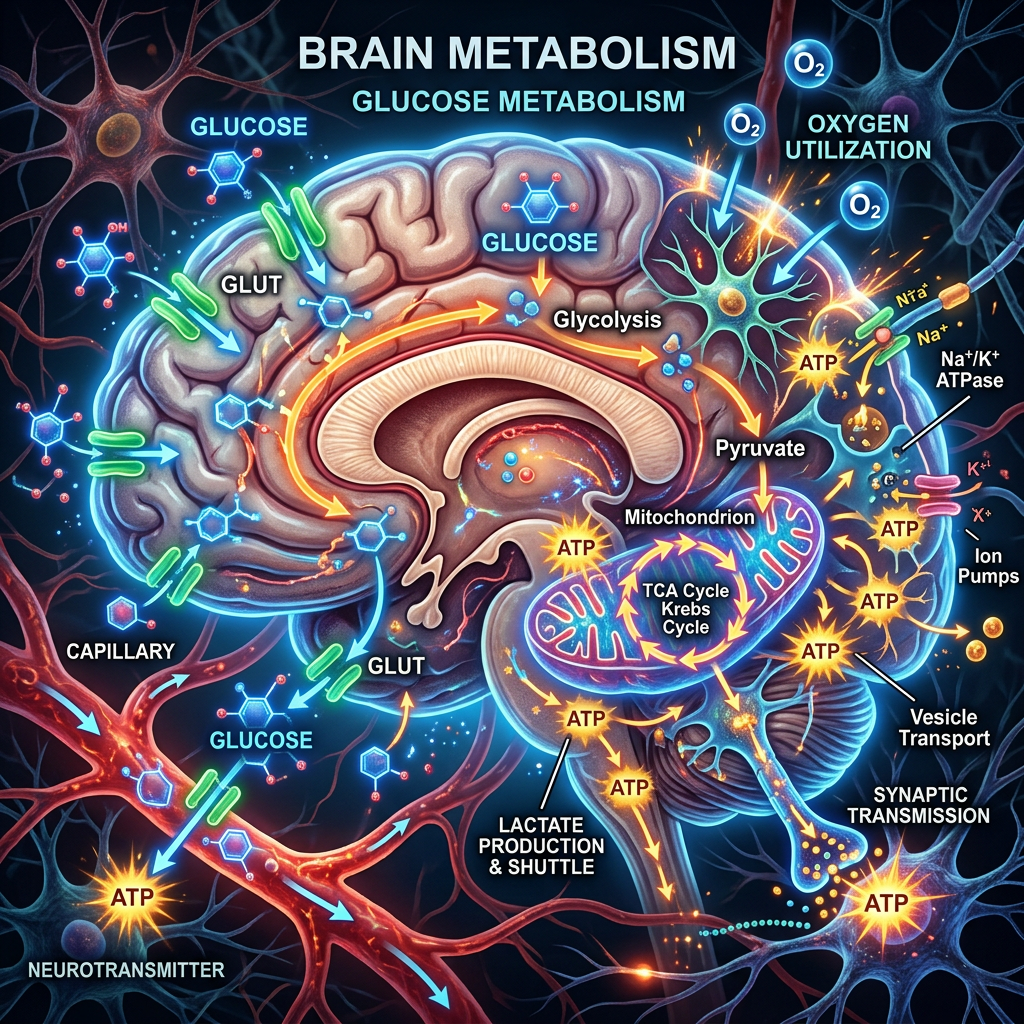
Diagram of brain glucose metabolism, oxygen use, ATP production, and neuronal energy pathways

In a July 2026 Open Access Government article, VA and University of Washington scientist James Meabon argues that FDG-PET (Fluorodeoxyglucose positron emission tomography), which uses a radioactive sugar tracer to show the brain’s glucose use, can expose blast injury where structural scans cannot. Tracking the executive-function problems of 79 blast-injured veterans, this Journal of Neurotrauma study found that a single deep-brain hotspot heightened glucose uptake in the left pallidum.

At the molecular level, a May 2026 npj Metabolic Health and Disease journal review details how blast-related injuries stall the brain’s energy cycle. In particular, metabolites – succinate, lactate, altered pyruvate-dehydrogenase activity – it “spills” into blood and urine.

While the work was funded by the Department of Defense, VA, and NIH, and focused on brain injury in the military, the findings are universally applicable. “By viewing blast injury through metabolism,” Meabon writes, medicine can move “from invisible injury to precision medicine.”

Your Eyes Can Reveal What’s In Your Brain

In March 2026, the University of Colorado Anschutz Medical Campus published the results of a study that reveals high-speed eye-tracking technology can detect lasting neurological damage from mild traumatic brain injuries. More so, it showed that the damage that can be detected may be completely invisible to MRI scans, CT imaging, and routine clinical exams. This matters enormously. Current standard concussion assessments are largely subjective and can result in patients being told they’ve recovered when their brains are still struggling.

At the CU’s Marcus Institute for Brain Health, researchers tested 78 military veterans and measured subtle disruptions in eye movement that expose hidden neural damage. The findings were sobering: deficits persisted 10 to 15 years after the original injury. As Dr. Jeffrey Hebert, who led the study, noted, “Even when someone feels recovered, their brain may still be working differently behind the scenes.” Funded by the Department of Defense, this technology offers something conventional medicine currently cannot – objective, documented proof of brain trauma.