Group-home Debate in NH Focuses on Those With Brain Disorders

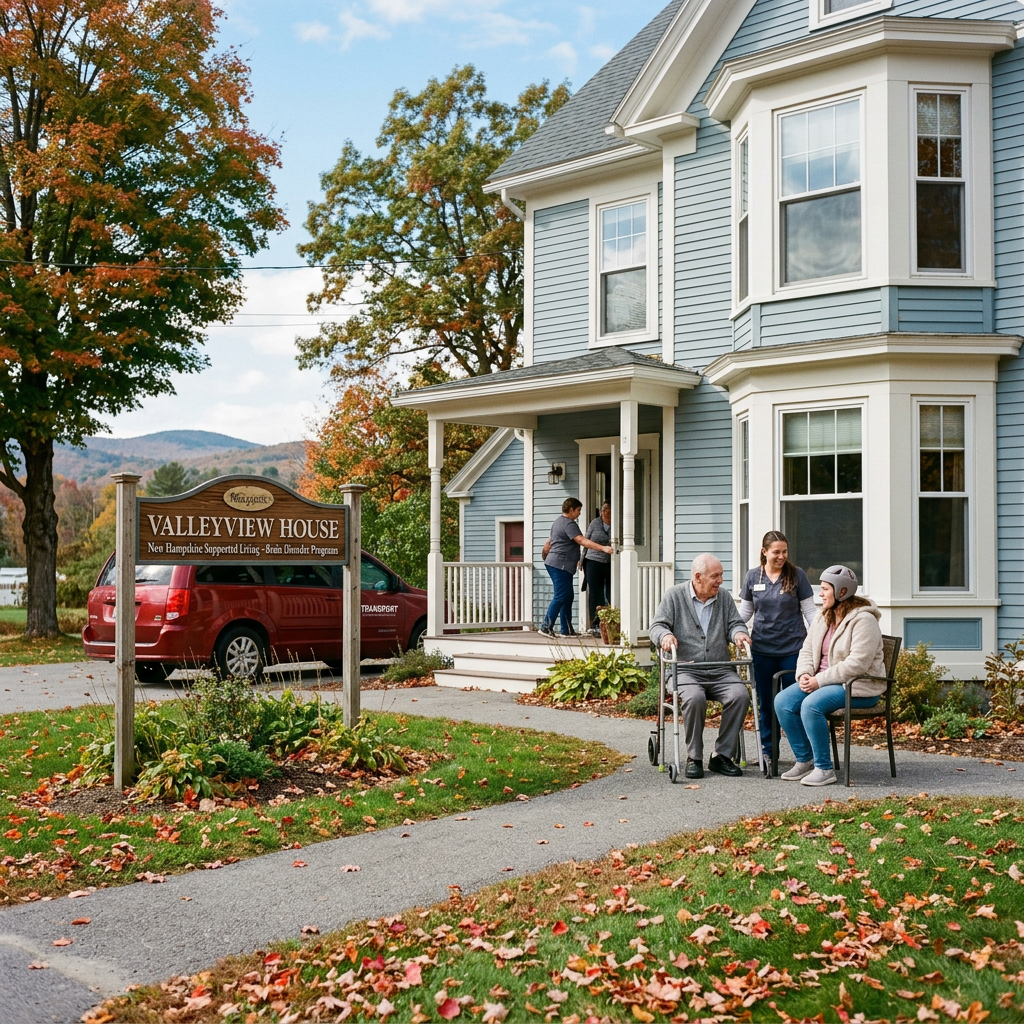
Elderly man with walker, young woman wearing helmet, and caregiver talking outside a blue assisted living home

New Hampshire’s group homes for people with brain injuries and developmental disabilities are getting new legislative scrutiny: Gov. Kelly Ayotte signed House Bill 1763 into law on June 19, 2026, creating a committee to study how these residences are sited, built and maintained statewide, and whether siting disputes push vulnerable residents from needed care.

The panel, which was formed after neighbors in towns like Bow objected to state-backed homes appearing without notice, must report findings by Nov. 1, 2026. Sponsor Rep. Mike Drago said “residents feel blindsided” when facilities open unannounced. Disability advocate Lisa Beaudoin countered that “it is perfectly safe to have people with developmental disabilities in one’s neighborhood.” More so, advocates state that it is needed, as New Hampshire’s estimated 2,000 residents with acquired brain disorders rely on such housing to stay near family and services.

New Hampshire isn’t first to grapple with this tension. California has guaranteed small group homes equal footing with single-family houses since 1978. Connecticut adopted similar zoning-parity protections around 1980, later adding density limits after litigation. New York took a study-first approach in 2025, forming a working group on group-home families – a path New Hampshire now follows, as well.

Brain Injury Prevention on the Slopes

Katie Watt, captain of the Bates College Nordic ski team, filed suit in December 2025 after a 597-pound unsecured bench shelter struck her during track practice in October 2024, causing a skull fracture and traumatic brain injury. The case, still pending, alleges the college failed to anchor equipment despite 30 mph winds.

Maine’s ski statute 32 M.R.S. §15217 establishes that skiers accept inherent risks, including terrain, weather, and collisions, “as a matter of law,” while preserving claims for negligent operation or maintenance. Similar statutes exist in Colorado, New Hampshire, and Utah, while Vermont statues uniquely void all liability waivers. (I was told by a lawyer that, based on their experience in New Jersey, a ski slope operator is culpable only when gross negligence is proven, such as if they dug a deep hole in the slope terrain.)

Evidence-based TBI prevention emphasizes helmet use which reduces head injury risk by 29-60%. Additionally, avoid terrain parks (31% higher head injury risk), and stop skiing by mid-afternoon when 40% of injuries occur. Groomed intermediate runs, proper lessons, and pre-season conditioning significantly reduce risk.

With proper precautions, skiers can enjoy the slopes safely while understanding their legal responsibilities.