
$2.44 Billion Reclaimed: Inside the VA Recoupment Fight

Two women exchange cash and a check at an office desk

Under a law dating to the 1940s, veterans who received separation pay, compensation for time served, had to repay it if they later qualified for VA disability benefits. (Federal rules barred receiving both.) The VA would withhold disability checks until the debt was cleared. From 2013 to 2023, this debt recoupment structure equaled $2.44 billion in separation pay and bonuses from 112,834 veterans.

To many, this payment structure may seem like punishment to the disabled veteran. In 2023, Senator Ruben Gallego’s (AZ) Restore Veterans’ Compensation Act of 2023 which would have barred this practice, arguing the two payments serve different purposes. Since that time, the bill has been reintroduced many times. Most recently, Representative Bilirakis (FL) brought the Restore Veterans’ Compensation Act of 2026 to Congress on January 13, 2026. (HR7027 was referred to the Subcommittee on Disability Assistance and Memorial Affairs on May 7, 2026.)

“It is ridiculous to claw back money from a veteran who has put life and limb on the line, just because later in life they qualify for disability benefits,” stated Gallego, acknowledging the fact that traumatic brain injury symptoms often surface or worsen years after service.

*The bill’s chief criticism is fiscal: ending recoupment means the government forfeits future collections.

No Pills, No Scalpel: Magnetic Pulse Treatment for Brain Injury

Healthcare professional applying a transcranial magnetic stimulation device to a patient's head in a clinical setting

Imagine treating a brain injury with no incision or pill, but just a magnetic coil held against the scalp. Transcranial magnetic stimulation (TMS) turns that promise into a reality, sending gentle magnetic pulses through the skull, so that misfiring brain circuits go back into rhythm. Long cleared by the FDA to treat depression, the painless technology is now being tested for treatment of traumatic brain injury and the lingering fog, headaches, and trauma it leaves behind.

Weighing TMS against combat-related PTSD, a 2026 systematic review examined a registry of 770 veterans who received TMS probes to determine how brain injury shapes treatment response. And, in a rigorous trial funded by the Department of Veterans Affairs, researchers at VA San Diego treated 70 veterans plagued by relentless headaches after mild brain injuries. Half of the study participants received real stimulation, while half received a placebo. After just ten sessions, published in early 2026, the magnetic group reported fewer headaches, in addition to sharper memory and attention.

Soon, a quiet magnetic coil may become a mainstay of brain-injury medicine.

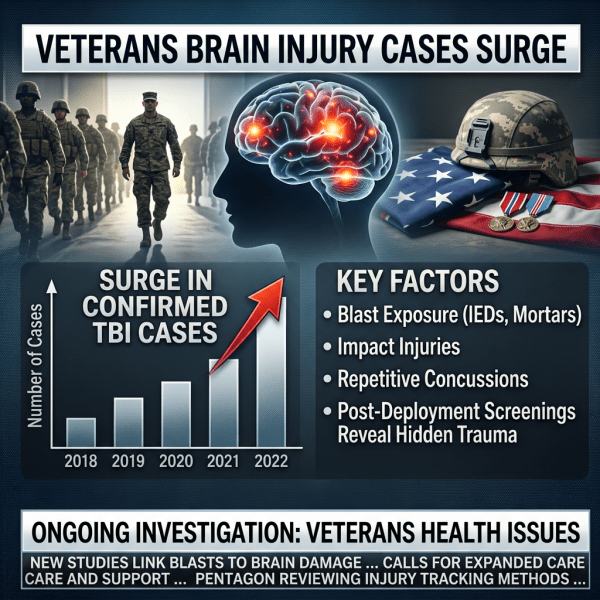
Veterans’ Brain-Injury Cases Surge as Research Funding Falls

Graph showing surge in confirmed veterans brain injury cases from 2018 to 2022 with key contributing factors

New data from the VA’s Traumatic Brain Injury Veterans Health Registry reveals that 556,502 veterans entered the registry between September 2001 and September 2025. (This 26 percent jump in just four years averages more than 28,000 new cases annually since 2021.) This data was make available in July 2026, just as the federal funding for TBI research has dropped from $175 million to $40.5 million. (Of course, this drop does not apply to state funding.)

In a joint statement, Disabled American Veterans National Commander Coleman Nee and Invisible Wounds Foundation CEO Shannon Connell urged Congress “to increase funding and direct greater focus toward service member and veteran-centered TBI research. The response from Congress has echoed this and crossed party lines. In a May 2026 hearing reviewing that budget, Senate Appropriations Chair Susan Collins blasted proposed budget reductions targeting the National Institutes of Health.” Rep. Mike Levin (CA) called the current level “a drastic cut from prior years” and pledged to fight for more funding.

Congress Has Been Flying Blind on Veteran Brain Injury Spending for Years

Shiny golden dollar sign with stacks of bills and coins behind

The Special Disabilities Capacity Report is Congress’s primary tool for deciding how much to invest in VA’s TBI treatment infrastructure. If the numbers feeding that decision are wrong, the veterans who depend on that care pay the price.

A February 2026 review by the VA Office of Inspector General revealed that in FY 2023, the VA reported the wrong financial data for traumatic brain injury, using obligations rather than actual expenditures, thereby overstating actual TBI spending. More so, they failed to report TBI spending at both the geographic service area and national levels as required by law. The DVA Office of Inspector General’s Report 25-01863-31 also determined that VA’s capacity data did not capture community care services or the extent to which bed capacity was used at its specialized rehabilitation centers.

Pointedly, these data errors are the same as those that have been flagged in prior years. This raises questions about whether Congress receives an accurate picture of VA’s TBI treatment infrastructure. As Iowa Rep. Mariannette Miller-Meeks, Chairwoman of the House VA Health Subcommittee, stated at a March 2026 oversight hearing: “Wrong data takes resources away from [other] areas of need.”