Honoring the Wounds We Cannot See

The Department of Defense’s Traumatic Brain Injury Center of Excellence counts 535,544 service members diagnosed with TBI since 2000, of which 77,892 of them moderate, severe or penetrating. To fill a gap in care for the most severely wounded, the Wounded Warriors Project launched its Independence Program (IP) in 2013. As WWP IP states, its mission is:
“Providing innovative, long-term support to the most catastrophically wounded veterans with a moderate to severe brain injury, spinal cord injury, or neurological condition that causes them to struggle with day-to-day living… that will help them live life to the fullest and as independently as possible. This one-of-a-kind program focuses on helping them set achievable goals, get more active in their community, and embrace the future on their terms….  [the] Independence Program starts with a comprehensive service assessment, during which your team of specialists will work with you, your family, and your caregivers to develop a plan of action…”

WWP is a nonprofit and its services are offered at no cost to the injured service member or their caregivers. Though not directly connected to the government, it has had numerous government associations through the years. Addressing the House and Senate Committees on Veterans’ Affairs this March, WWP CEO Walter E. Piatt stated, “while we can never prevent traumatic things from happening, we can continue to work diligently to eliminate the disorder that can arise from those experiences.” As such, he further explained the Independence Program: “currently serving nearly 1,000 warriors… IP is a small but critical part of a larger ecosystem of care and support,” that delivered nearly 285,000 hours of care in fiscal 2025.
Benefits of Exercise after TBI

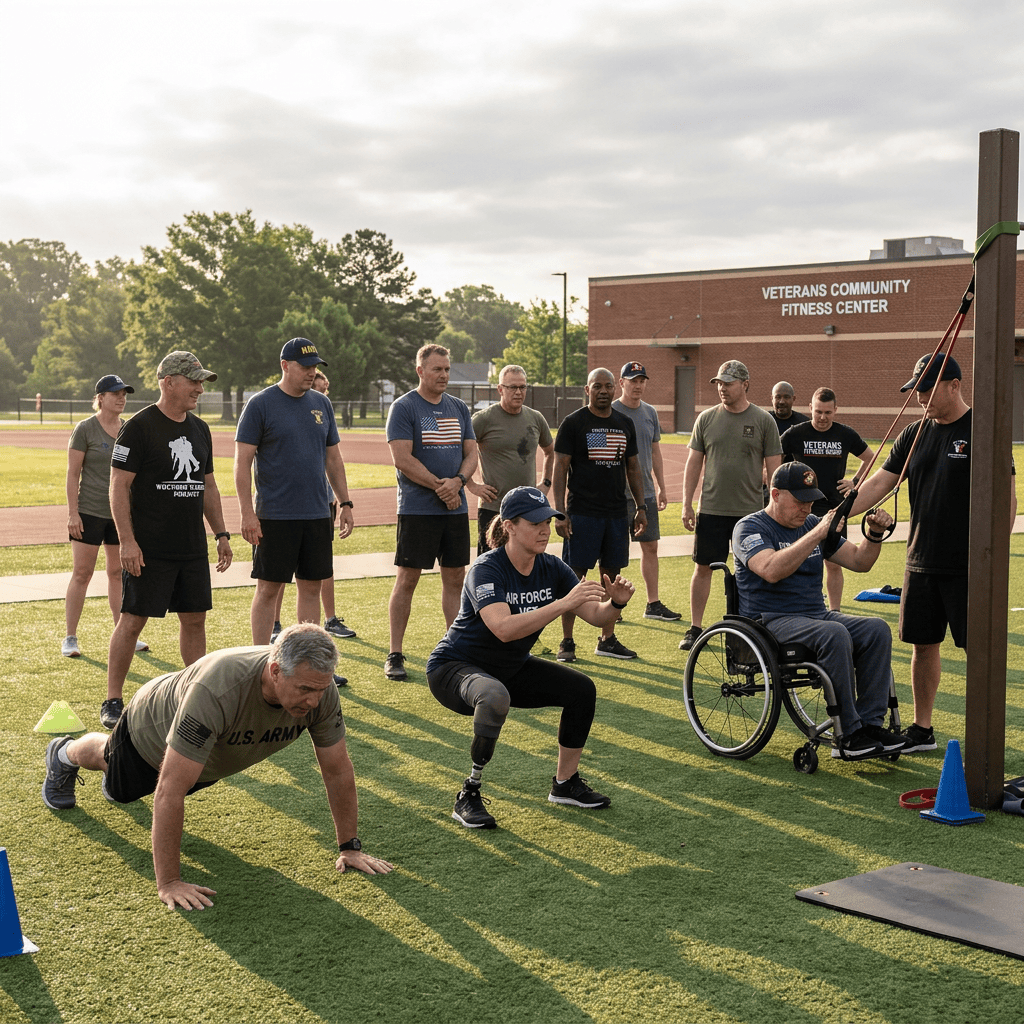
Veterans performing adaptive fitness exercises on an outdoor athletic field

In 2013, the University of Buffalo found that of the four participants who underwent daily aerobic exercise, all benefited neurologically, particularly in decreasing exhaustion.  In 2015, the National Institute of Health (NIH) conducted a 12-week study with the same results: “individuals with TBI may benefit from participation in vigorous aerobic exercise training with improved cardiorespiratory fitness and diminished fatigue.”  Currently, the University of Kansas is performing a two-year, $500,000 clinical study, sponsored by the Department of Defense, to see if the same applies to wounded warriors.  (The reason why this is even a question is because traditionally, rest is the recommended remedy for a “knock to the head”.)

As opposed to the Buffalo study, the study in Kansas will include more than 100 hundred wounded warriors, stationed in Fort Riley, all of whom were affected by explosive devices.  Also, as the leaders of the study and exercise trainers will agree, all exercise is not the same and does not provide to same benefits.  Therefore, “instead of lifting weights, we want the soldiers running more to improve their aerobic capacity,” says David Johnson, the leader of the study, explaining the aim of the study in a news release.  Beyond fatigue, the study expects to find that aerobic exercise helps the brain heal in other ways, such as in memory and thinking, anxiety and depression.  While this study is focused on the benefits of exercise for those with mild traumatic brain injury, the results may have benefits for other neurological conditions, such as in aiding those with severe TBI, Alzheimer’s disease, etc.  More so, it could reaffirm the neurological benefits of exercise for all.