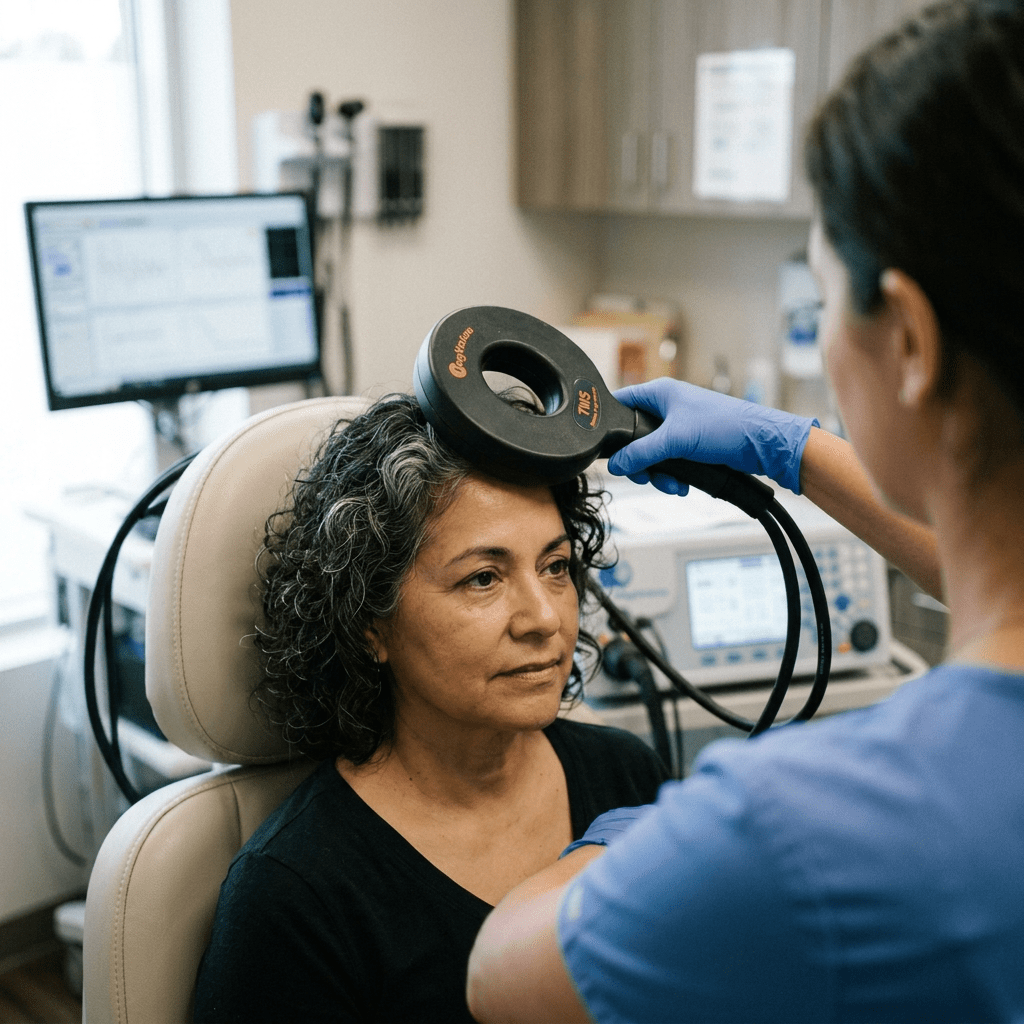
Imagine treating a brain injury with no incision or pill, but just a magnetic coil held against the scalp. Transcranial magnetic stimulation (TMS) turns that promise into a reality, sending gentle magnetic pulses through the skull, so that misfiring brain circuits go back into rhythm. Long cleared by the FDA to treat depression, the painless technology is now being tested for treatment of traumatic brain injury and the lingering fog, headaches, and trauma it leaves behind.
Weighing TMS against combat-related PTSD, a 2026 systematic review examined a registry of 770 veterans who received TMS probes to determine how brain injury shapes treatment response. And, in a rigorous trial funded by the Department of Veterans Affairs, researchers at VA San Diego treated 70 veterans plagued by relentless headaches after mild brain injuries. Half of the study participants received real stimulation, while half received a placebo. After just ten sessions, published in early 2026, the magnetic group reported fewer headaches, in addition to sharper memory and attention.
Soon, a quiet magnetic coil may become a mainstay of brain-injury medicine.
Per the CDC, roughly 1 in 4 sexually active American women have used the form of birth control Depo-Provera. Studies, though, found that the effects of this injectable go beyond contraception. The government paper trail also keeps growing, regarding the risks it may cause. A JAMA Neurology study found a 2.43-fold higher risk for developing a brain tumor among users. Just this month, on July 2, 2026, another JAMA study flagged the injection as having the strongest risk of brain tumor development of any contraceptive. (This study also reported reassuring news: risk fades within roughly five years of stopping. Additionally, absolute risk stays low, as less than 5 in 10,000 women have this extremely negative effect.)
According to the Mayo Clinic, “Depo-Provera is a birth control shot that has the hormone progestin.” In actuality, it injects medroxyprogesterone acetate, a synthetic version of the natural hormone progesterone. Long-term use of this injection can result in meningiomas, which are usually benign brain tumors. Meningiomas, though, can crowd the brain, triggering headaches, vision loss, and seizures. In December 2025, the U.S. Food and Drug Administration ordered a warning on the Depo-Provera label.
Meanwhile, Pfizer reached a June 2026 settlement covering over 5,500 federal lawsuits alleging it downplayed the danger. Though this number may seem large, the percent of Depo-Provera users it represents is small. So, users shouldn’t panic but should talk to their doctor about duration of use.
For some survivors, uncontrollable gain weight can be a consequence of a brain injury. The condition, known as acquired hypothalamic obesity, strikes when there is damage to the hypothalamus, the brain region that regulates hunger and energy balance. Once that control center is disrupted, patients are left with relentless hunger and rapid weight gain that resists diet and exercise alone. (Most often, the condition follows treatment for brain tumors, but traumatic brain injuries and strokes can trigger it too.)
Those with this condition previously have nowhere to turn for real help, but that changed on March 19, 2026: the U.S. Food and Drug Administration approved setmelanotide, sold as Imcivree, as the first therapy specifically designated for this rare disease. The drug works by restoring hormone signaling along the MC4R pathway, which is the same circuit the injury disrupts.
The approval followed the largest placebo-controlled study ever conducted for this condition, published in the New England Journal of Medicine on July 8, 2026. Patients on the drug saw a 16.5 percent average drop in BMI, compared with a 3.3 percent increase among those on the placebo. Trial co-author Dr. Reema Habiby confirms, “These results offer real hope to children and families who have had very few options.”
Bayer’s OCEANIC-STROKE trial found asundexian cut recurrent ischemic stroke, secondary stroke, by 26% without significantly raising bleeding risk, revealed a study, published April 15, 2026. After these encouraging study results, on May 19, 2026, Bayer announced the U.S. Food and Drug Administration granted priority review for asundexian, an investigational once-daily pill, for patients following a non-cardioembolic ischemic stroke* or transient ischemic attack**.
Stroke is an acquired brain injury and surviving one does not eliminate the danger. The CDC estimates stroke costs the U.S. $56.2 billion annually, straining Medicare and Medicaid. Federal programs like Million Hearts, co-led by CDC and CMS, reflect Washington’s focus on this crisis.”Secondary stroke remains a serious and persistent challenge, and the FDA’s Priority Review designation underscores the urgency of advancing potential new approaches,” said Yesmean Wahdan, M.D., of U.S. Medical Affairs at Bayer. Affecting roughly one in ten survivors within one year, a secondary stroke occurs when the same underlying conditions that caused the first, such as arterial damage and clot formation, go unresolved. Recurrences are often more severe, causing greater disability or death.
Reserved for treatments that could improve care for serious conditions, the designation accelerates the FDA’s review from ten months to six.
*Per NIH: A non-cardioembolic ischemic stroke occurs when a blood clot blocks an artery supplying blood to the brain, but the clot originates locally (e.g., from narrowed neck arteries or plaque rupture) rather than traveling from the heart.
**Per NIH: A transient ischemic attack (TIA) is a medical emergency. It is defined as a transient episode of neurologic dysfunction due to the focal brain, spinal cord, or retinal ischemia without acute infarction or tissue injury.
“Justice Department Places FDA-Approved Marijuana Products and Products Containing Marijuana Subject to a Qualifying State-issued License in Schedule III, Strengthening Medical Research While Maintaining Strict Federal Controls.” This headline, which appeared on the Department of Justice’s official website on April 23, 2026, refers to the Executive Order signed by President Trump.
Advocates and politicians have pushed for this change for years, arguing cannabis carries undeniable medical value. As of April 2026, medical marijuana use is legal in 40 states. Following many years of federal research that confirmed the potential benefits of marijuana use for medical conditions, this Executive Order reclassifies state-licensed medical marijuana from Schedule I, the most restrictive federal drug category, to the less regulated Schedule III. Acting Attorney General Todd Blanche stated the decision, “allows for research on the safety and efficacy of this substance, ultimately providing patients with better care and doctors with more reliable information.”
For brain injury survivors, the implications may be significant. One study, available on PubMed, found that patients with acquired brain injury have reported improvements in mood, anxiety, headache, sleep, and quality of life through medical cannabis use. Government-funded research also indicates that the non-psychoactive cannabis compound CBD, and THC, the primary psychoactive compound in cannabis that is responsible for the “high”, may be effective for pain management, anxiety, and insomnia, all of which are common symptoms following brain injury. (These benefits are debatable. Another major analysis found that medicinal cannabis does not effectively treat anxiety, depression, or PTSD, and may even worsen mental health in some cases.)
As always, caution is warranted. The CDC has proven that cannabis use affects brain development. Beyond brain development, a 2024 CDC report states, “cannabis use directly affects brain function — specifically the parts of the brain responsible for memory, learning, attention, decision-making, coordination, emotions, and reaction time.” Chronic marijuana consumption may reduce dopamine responsivity, increase negative emotionality, and induce anhedonia, meaning a reduced ability to experience pleasure or a loss of interest in previously enjoyed activities. These possible negative consequences are a significant concern for survivors, who already have cognitive issues and may struggle with low motivation.
While this rescheduling opens the door to better science, always consult a physician before using cannabis.
Northwestern University scientists have developed an injectable nanomaterial, dubbed “dancing molecules”, that cross the blood-brain barrier and shield brain tissue from post-stroke damage. Published January 2026 in Neurotherapeutics, the therapy uses tiny, constantly moving molecular assemblies, known as supramolecular therapeutic peptides (STPs), delivered intravenously that self-organize into nanofibers inside injured brain tissue. In mice, a single IV dose given after blood flow was restored significantly reduced inflammation, tissue death, and harmful immune response with no observed toxicity.
In July 2025, Amphix Bio, the company behind the treatment, posted on LinkedIn: “We are thrilled to announce the FDA has granted an Orphan Drug Designation to AMFX-200, our lead candidate based on the Supramolecular Therapeutic Peptide (STP) platform, for the treatment of acute spinal cord injury. This will accelerate our efforts to bring this novel neuro-regenerative therapeutic to the clinic.”*
* I cannot find any record of human trials of this stroke treatment, as of yet. Additionally, key limitations remain, as results are preclinical only, dosing must be precise to prevent blood clotting, and long-term human safety is unproven.
Activated charcoal, long used in emergency rooms to treat poisoning, is emerging as a potential tool for preventing and treating brain injury. A March 2025 Canadian multicenter study published in the Canadian Journal of Emergency Medicine found that poisoned patients treated with activated charcoal had a 9.2% lower risk of increased toxicity, critical for preventing the brain damage that often follows severe overdoses.
Regular charcoal and activated charcoal are fundamentally different, as the former can actually cause brain damage. According to the Consumer Product Safety Commission, approximately 20 Americans die annually from carbon monoxide poisoning linked to charcoal grills used indoors, with survivors often suffering permanent neurological damage. The potential risk occurs because cooking charcoal undergoes simple carbonization, while activated charcoal receives additional treatment at extreme temperatures, creating a surface area exceeding 500 square meters per gram – five times greater than regular charcoal. This porous structure enables it to adsorb toxins before they reach the bloodstream and brain.
Currently, the Food and Drug Administration does not approve of activated charcoal as a food addictive or coloring agent, and in New York and other cities, it is banned for use in food and drinks. (Concern is due to the fact the activated charcoal is reported to cause constipation and nutritional deficits, as it can harden in the intestines.) Specifically related to traumatic brain injury, though, NIH-funded researchers at Rice University have developed oxidized activated charcoal nanoparticles that restore cerebral blood flow in animal models. According to StatPearls, the NIH’s clinical reference guide, updated in 2025, “Activated charcoal is most efficacious when given within one hour of ingestion of the toxin.”