NYT Reports “At Least 1 in 4 N.F.L. Players Gets Brain Disease”

A New York Times article published yesterday, August 25, 2026, focuses on a study published this week in BMJ: at least one in four former N.F.L. players who died between 2016 and 2021 had chronic traumatic encephalopathy. While The Times’ headline, Study’s Alarming Finding: At Least 1 in 4 N.F.L. Players Gets Brain Disease, captures the reader, it and the study itself omit an even grimmer finding: it appears that only about approximately a quarter of the 878 players who died had their brains examined. The real risk for CTE could be almost one hundred percent.

Worn navy football helmet with number 24 on a wooden bench

CTE comes from the cumulative force of repeated head impacts. (No tackle football position is safe, but low-contact positions like punters and kickers are the safest, while linemen absorb thousands of blows.) Roughly 60% of the players found with CTE had dementia and severe impairment, including an inability to feed or groom themselves.

This isn’t a call to ban tackle football. But public universities, however lucrative their football programs may be, are taxpayer-supported government institutions. Perhaps lawmakers should at least weigh the benefits and drawbacks of the sport on college campuses before federal funds are provided.
Helmet Lab Results Expose Need for New Youth Standards

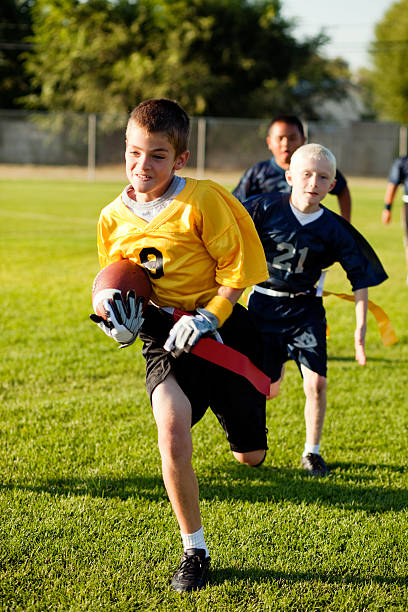
Brain damage, particularly CTE, has widely been discussed in the past decades as a negative consequence of football. Beyond action on the field, a growing body of research reveals that this damage may be exasperated by the equipment worn by players to prevent harm. Research links heavier football helmets to increased brain injury risk in young players.

Virginia Tech’s Helmet Lab found that children, whose neck muscles are weaker and heads proportionally larger than adults’, are especially vulnerable – sustaining concussions at approximately 60g of head acceleration, compared to roughly 100g for college athletes. This knowledge has resulted in a drive of both equipment reforms and legislative action for youth football across the United States. Led by the National Operating Committee on Standards for Athletic Equipment, new StandardND005 regulations were finalized in July 2025. Youth football helmets must be a maximum of no more than 3.5 pounds, effective September 1, 2027.

States are also not waiting. In West Virginia, Senate Bill 657, the Cohen Craddock Student Athlete Safety Act, named for a 13-year-old who died August 24, 2024, from a football-related brain injury, advanced through the Senate Education Committee on February 12, 2026. The bill would allow schools to adopt protective soft-shell helmet covers during practices. At the federal level, Senator Durbin (IL) introduced S.2889 on September 18, 2025, conditioning federal education funding on state-level concussion safety protocols. (Beyond this initial reading, no further action appears to have been taken.)

Football: The Government Gets Into The Game

This past year, special attention has been given to the link between football and brain injury, particularly in the NFL.  For good reason, this past season, the incidences of concussion in the NFL rose by 58% – from 182 to 271.

The National Institute of Health, in association with Boston University, studied the brains of 91 deceased NFL players, finding that 96% of them had some form of brain injury – a stunning number, but not surprising from a sport that is rife with head-to-head defensive collisions.

Naturally, “The NFL rejects the allegations,” said NFL spokesman Brian McCarthy.  In fact, the NFL initially offered to donate $30 million to fund this study – perhaps to surreptitiously sway the findings.  However, when they found that Robert Stern, Boston University researcher and an expert on the link between football and TBI, was leading the study, the NFL dropped its promised donation.

What I do not understand is how the NFL can deny the magnitude and relevance of these statistics, especially in a study of now deceased players.  They also say that Mr. Stern was biased.  Personally, I do not understand how the NFL can claim someone can be biased on a study that relies on statistics.  Furthermore, Mr. Stern may have personal feelings about the link between brain trauma and football, but I do not believe, as an expert in the field, he would sacrifice accuracy for point of view.

Lastly, I do not think that there is a person in this country who, if asked, does not have an opinion on football and its potentially negative effects.