Tiny “Brain” Yields Big Answers About Concussions

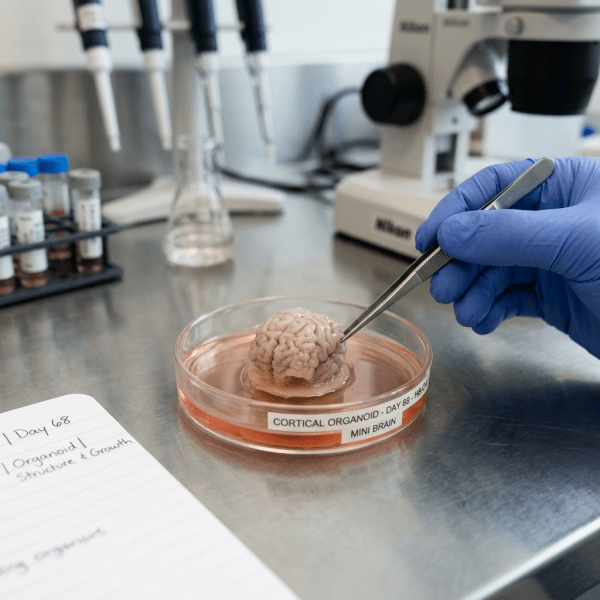
Gloved hand holding tweezers manipulating a miniature brain organoid in a petri dish on a lab bench

What if a pea-sized cluster of lab-grown cells could unlock the mysteries of brain injury? Researchers at the University of Cincinnati’s College of Engineering and Applied Science have been doing just that:

Reported by UC on April 21, 2026, UC Assistant Professor Volha “Olga” Liaudanskaya has engineered a tiny, functioning replica of human brain tissue that researchers can safely study. Termed a “mini-brain”, these lab-grown models combine three types of brain cells with two vascular cell types. This, then, creates a complex five-cell system she can observe in living tissue. Simulating concussions and mild traumatic brain injuries on this model, UC engineers can uncover how blunt-force impacts trigger cellular chain reactions that may ultimately lead to long-term neurodegenerative diseases. (Prior models lacked the vascular components, which researchers now recognize as key, driving brain inflammation and degeneration, perhaps reshaping how America protects its athletes, veterans, and kids.)

According to 2026 estimates by the Centers for Disease Control and Prevention, children alone sustain nearly 4 million concussions every year, so the results of this “mini” innovation may be enormous.

Phantom Brain Emerges from NRL/VCU Collaboration

“The word ‘phantom’ may conjure up scary ideas, like ghosts, delusions or fake bank accounts… [but] medical imaging phantoms are objects used as stand-ins for human tissues,” according to the National Institute of Standards and Technology of the U.S. Department of Commerce. “Phantoms offer… comprehensive assessments and iterative optimization of imaging modalities… enabling improvements in their chances of success before human studies,” reported the NIH in May 2024.

Announced December 8, 2025, scientists at the U.S. Naval Research Laboratory in Washington D.C. and Virginia Commonwealth University in Richmond have developed the first anatomically accurate rat brain phantom capable of measuring traumatic brain injury impacts in real time. This breakthrough emerged from a multi-year partnership between NRL physicist Dr. Margo Staruch and VCU professor Dr. Ravi Hadimani.

The phantom uses a custom gel-like material that mimics real brain tissue’s consistency.  Working like a tiny power generator activated by pressure, an embedded sensor converts physical impacts into measurable electrical signals. It replicates the brain’s distinct layers: skull, cerebrospinal fluid (the protective liquid cushioning the brain), gray matter, and white matter.

“That information can directly inform the design of improved helmets and protective gear, leading to better protection for warfighters and will also contribute to better diagnostic and treatment pathways for TBI,” said Staruch.