Illinois Bipartisan Act Modernizes Stroke Care

Illinois State Capitol building with banner and informational signs about stroke care and prevention

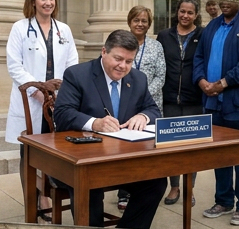
Illinois has updated how it recognizes the hospitals that treat one of the most common forms of acquired brain injury. On July 31, 2026, Gov. JB Pritzker signed HB5494 into law as Public Act 104-0706, effective January 1, 2027.

The statute directs that “the approved stroke designation levels shall coincide with the stroke designation levels recognized by Department-approved certifying bodies,” keeping Illinois aligned with national standards. It amends the Emergency Medical Services Systems Act, broadening “Primary Stroke Centers” to “Stroke Centers”. Additionally, it empowers the Illinois Department of Public Health to update designation levels and reporting through administrative rulemaking in consultation with the State Stroke Advisory Subcommittee.

No recorded statement has been made by any state politician regarding HB5494, as of yet. However, the measure was strikingly bipartisan, passing the House 112-0 and the Senate 56-0, with Democratic Rep. Barbara Hernandez as lead sponsor and Republican Senate Leader John Curran among its Senate sponsors.


Illinois Expands Coverage for Common Consequence of Brain Injury

Speech therapist pointing at speech sound cards while boy looks and practices using a mirror

Illinois has strengthened access to speech therapy for people recovering from brain injuries. On June 26, 2026, Gov. JB Pritzker signed SB 2899 into law as Public Act 104-0528. The measure amends the Illinois Insurance Code and Public Aid Code to require coverage of rehabilitative services for individuals under 19 with an early acquired speech-language disorder. It also directs Medicaid to cover rehabilitative stuttering therapies for those 21 and under. The insurance provisions take effect January 1, 2028.

The change matters for brain injury survivors, as rehabilitative speech therapy is often central to recovery. By mandating coverage of rehabilitative care, the law helps ensure that survivors have access to therapies designed to help them regain their ability to communicate.

As Senator Willie Preston (IL-16), the bill’s sponsor, said “young people [now] have access to the tools, support and treatment they need to find their voice and be heard.”

The Chemical Time Bomb in Orange County

Workers in high-visibility vests wearing masks walking in a dusty warehouse near caution-taped barrels

A catastrophic chemical emergency has engulfed Orange County, California, forcing more than 50,000 residents to flee after a massive tank of methyl methacrylate ruptured at the GKN Aerospace facility in Garden Grove. Governor Gavin Newsom declared a state of emergency. President Trump also approved of Newsom’s request for federal aid, unlocking critical FEMA resources to help stabilize the crisis.

What many people don’t realize is that many chemicals, including methyl methacrylate, don’t just threaten the lungs. They also target the brain. Research published on NIH’s PubMed has found that methyl methacrylate causes measurable neurological deficits in exposed industrial workers, impairing memory, learning, and movement. One study documented that vapor exposure depressed electrical activity in the hippocampus, the brain’s memory center. The neurological symptoms of exposure, like headaches, lethargy, and a heavy, numb sensation in the limbs, can take days or weeks to appear.

As research further reveals, chronic exposure can cause degenerative changes in the brain and permanent nerve damage. Children, the elderly, and those with respiratory conditions face the greatest risk. As Garden Grove begins to recover, the invisible injury to thousands of brains is only beginning to unfold.

Workers in high-visibility vests wearing masks walking in a dusty warehouse near caution-taped barrels

This concern over industrial chemical dust is not new. California already has the strictest regulations on chemical plants and manufacturers of any state. Proposition 65 states that these companies must provide public warnings if they emit or use hundreds of chemicals linked to cancer or reproductive harm. Beyond just being one of the first states to mandate regulations, New Jersey also imposes some of the most rigorous chemical safety and security standards. Additionally, with the Matt Haller Act, Illinois enforces some of the strictest emission regulations. As Illinois Senator Dick Durbin captured in a 2017 letter addressed to the CDC Director: “It is clear that public exposure to [industrial chemical] dust can lead to serious health, safety, and environmental issues.”

Two (Disabled) Candidates Battle for Illinois Senate Seat

This is unexpected, and long overdue, news in this country: Two disabled candidates are currently in a fight for a Senate seat in Illinois.  Senator Mark Kirk (R), who in 2012 suffered a stroke, and Representative Tammy Duckworth (D), who lost both of her lower limbs when her plane was shot down in Iraq, are currently in a fight for the Illinois Senate seat formerly held by Barack Obama.  However, just like many female politicians are not specifically looking for the “woman vote”, it may not be a negative that both of these candidates have a disability.  A disability is not a call for pity and, because both of them live with their respective disabilities, their constituents can vote on what’s really important – their politics!