Senate’s College Sports Overhaul Includes Safety

On June 2, the Protect College Sports Act, S.4668, was introduced June 2 by Senate Commerce Committee Chairman Ted Cruz (TX) alongside Ranking Member Maria Cantwell (WA), Senator Eric Schmitt (MO) and Senator Chris Coons (DE). Chiefly an overhaul of name, image and likeness rules, “It [also] establishes strong health and safety protections,” stated Cruz on June 3, a day that was headlined by a hearing with the former Alabama coach Nick Saban. The legislation would require concussion and brain-injury safety standards enforced by independent officers and create a $60 million annual trust fund for long-term conditions such as CTE.
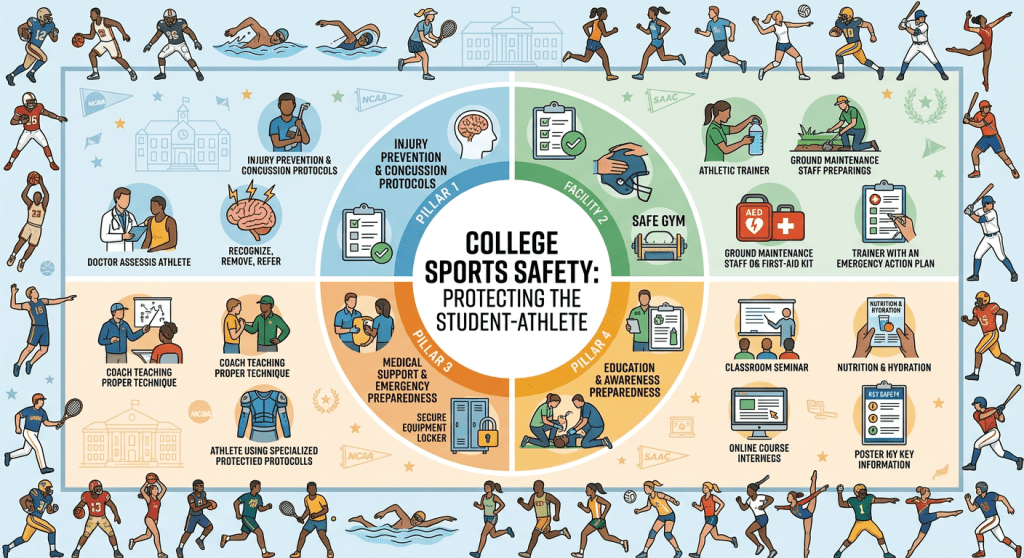
Infographic showing four pillars of college sports safety: injury prevention, facility safety, medical support, and education preparedness.

The committee voted 19-9 on June 18 to advance it, and it now sits on the Senate calendar awaiting a floor vote. Last week, on July 13, 2026, the bipartisan Protect College Sports Act picked up two new backers, as Senators Shelley Moore Capito (WV) and Peter Welch (VT) signed on as cosponsors. Days later, Senator Eric Schmitt told the Associated Press Sports Editors that they “probably have 60 votes,” meeting the threshold the measure needs to clear the full Senate.

The bill is backed by the NCAA but is opposed by the SEC and Big Ten. However, this opposition appears to be against financial aspects of the bill and about over government overreach, and not about new safety standards. Additionally, a House companion bill, H.R. 9137, remains in committee. President Trump has urged passage “this summer”.
When the Vault Goes Wrong: Pole Vaulting and the Risk of Brain Injury

A student athlete from Eastlake North High School in Ohio is recovering after sustaining a brain injury during a pole vault event at a track meet at Mayfield High School. According to reports and community updates, the student athlete’s pole broke while he was vaulting at maximum height. He fell straight down and struck his head on the vault box, a metal plant box that holds the pole.

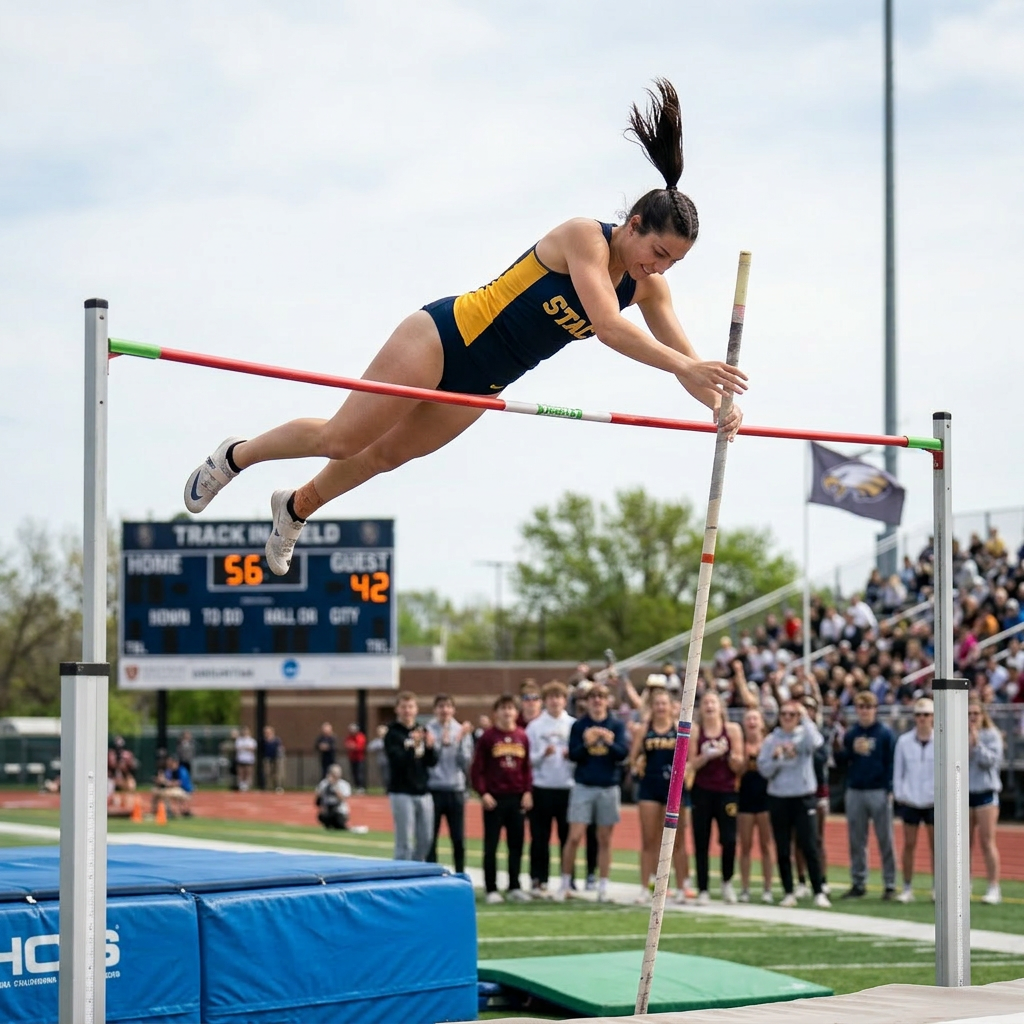
Female athlete in a blue and yellow uniform vaulting over a high bar with pole during a track and field event

Outdoor track and field is the most popular sport for girls at the high school level, with 513,808 participants in 2024–25, and participation on the boys’ side surged to 644,235 athletes during that time period. Recently, social media and sports streaming platforms have also enhanced pole vaulting’s visibility, which has attracted new entrants and expanding its base.

Despite its appeal, pole vaulting carries serious risks. A 2001 NIH-indexed study in the American Journal of Sports Medicine reviewed 32 catastrophic pole vault injuries reported between 1982 and 1998, finding that all occurred at an average age of 17.5 years, with 31 being catastrophic head injuries. Three means of injury dominated: athletes landing with their body on the pad but their head striking surrounding hard ground, missing the pad entirely, and prematurely releasing the pole. A 2012 follow-up study, also indexed on PubMed, found that from 2003 to 2011, 19 catastrophic injuries occurred. Averaging 2.1 per year, it was reported that 74% of these injuries involved athletes landing in or around the vault box, with 58% resulting in major head injuries.

Rule changes in 2003 by the NCAA, NFHS [National Federation of State High School Associations], and USA Track and Field – including enlarged landing pad dimensions – led to an 88% reduction in catastrophic injuries, with no fatalities reported since. Still, risks remain. Athletes can reduce injury risk by using properly rated poles, training under certified coaches, and considering ASTM [American Society for Testing and Materials]-certified helmets. Recent 2026 NFHS rule changes also clarified that padding requirements now apply to raised concrete or platform extensions above ground level that pose injury risks during falls.

The Eastlake North case is a reminder that even with two decades of safety improvements, more must be done to protect young athletes who soar.