
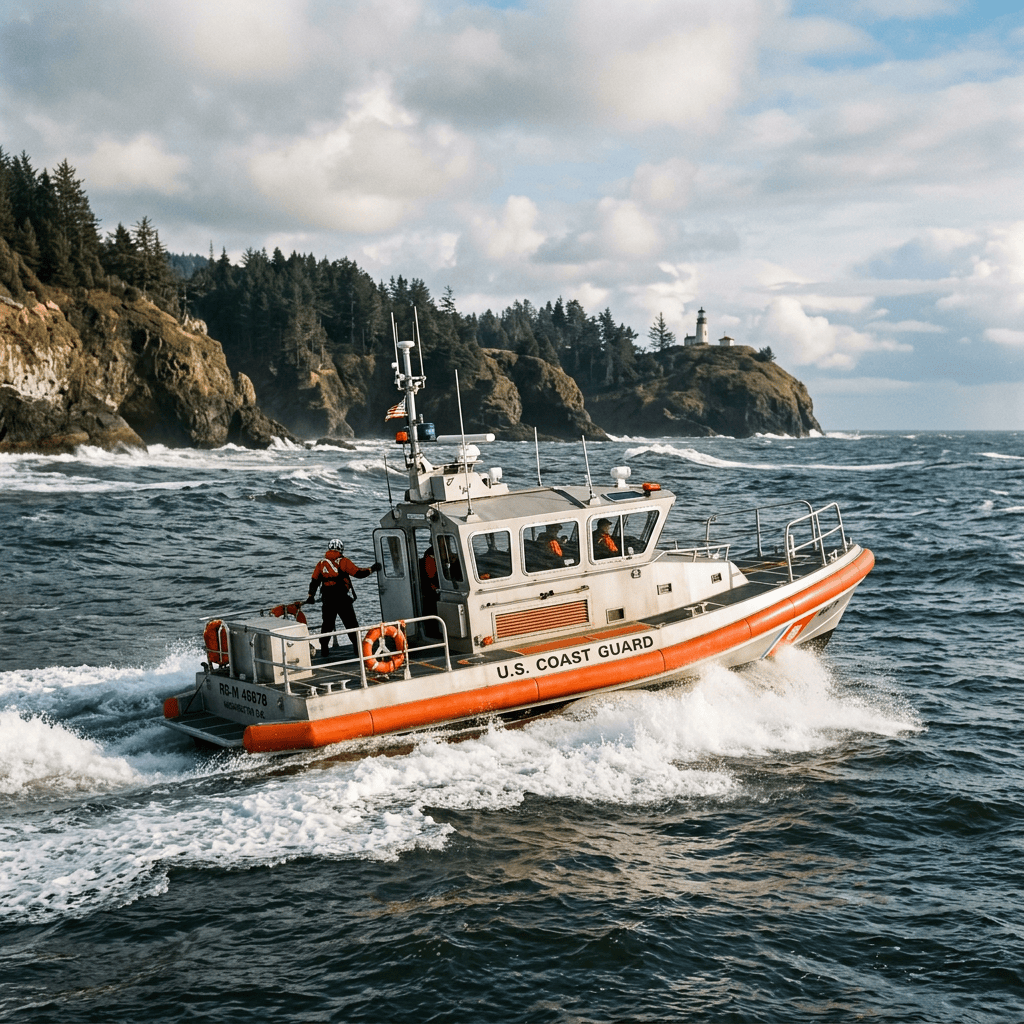
Coast Guard “surfmen” continuously absorb thousands of violent wave impacts while piloting rescue boats through rough surf. As the director of the University of Miami’s concussion program told the local NBC affiliate, “These are… significant waves, and sometimes it’s like hitting a concrete wall.” On July 31, 2026, US Coast Guard finally acknowledged the danger, through Admiral Kevin Lunday’s statement: “We owe it to [the crew] to protect [their] long-term health from the damage caused by relentless wave pound, blast overpressure and other concussive events that may cause injury.”
This reckoning was prompted by a citizen-investigation by 18-year-old Kayleigh Bonner, whose surfman father died by suicide in 2025. Soon after, this information was picked up by the New York Times, who reported that the service “has never studied the hazard that waves may pose to the brain.”
Repeated impacts can cause cumulative brain trauma, CTE-like degeneration, as the brain moves back-and-forth inside the skull. It has been determined that fast-boat operators have a roughly 45 percent chance of traumatic brain injury, but recreational boaters, powerboat racers, and commercial mariners are at risk too.
The US Coast Guard now pledges decisive action to better prevent, detect, and treat those effected by the impact of consistent wave pounding, and other such neurologically damaging events. On an individual scale, precautions include shock-mitigating suspension seats, gravitational force (G-force) sensors, speed limits, medical baselines, and prompt symptom reporting.

