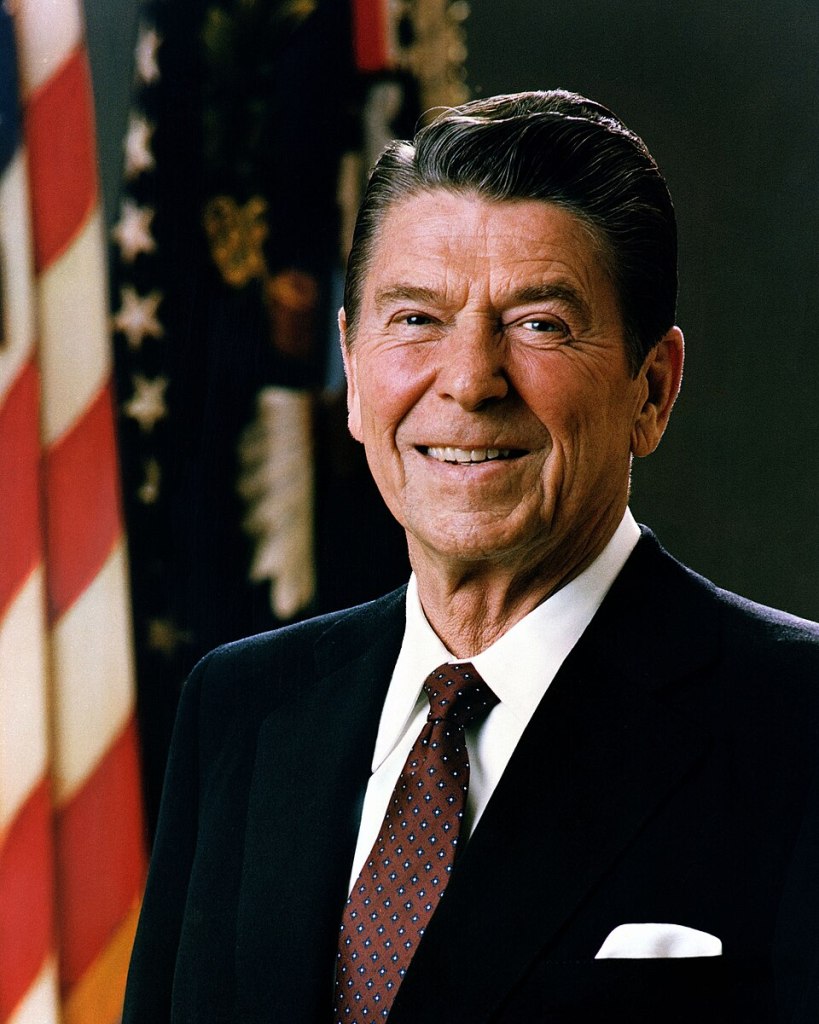
From Supporter to Survivor: Legacy of America’s 40th President

On what would have been his 115th birthday, TBIontheHill honors Ronald Reagan, America’s 40th President of the United States:

President Ronald Reagan left an enduring mark on the brain injury community when he signed Proclamation 5262 in October 1984, designating National Head Injury Awareness Month. This landmark action acknowledged the 700,000 Americans hospitalized annually for head injuries and called for greater research and support.

Reagan himself experienced traumatic brain injury firsthand. On July 4, 1989 – just months after leaving office – the 78-year-old was thrown from a bucking horse at a friend’s ranch in Mexico. The fall caused a subdural hematoma, a dangerous blood clot between the brain and skull. After initial treatment, doctors discovered a second clot requiring brain surgery at the Mayo Clinic in September 1989.

Because the accident occurred after his presidency, it did not affect his time in office. However, Nancy Reagan later wrote that she believed the severe head injury “hastened the onset” of her husband’s Alzheimer’s disease, diagnosed in 1994. Research supports this connection, as moderate brain injuries increase Alzheimer’s risk 2.3 times, while severe injuries raise it 4.5 times.

Reagan’s presidency transformed America – ending the Cold War, spurring economic growth, and restoring national optimism. His personal experience with brain injury adds poignant context to his earlier advocacy, creating a legacy for millions affected by neurological conditions.

Critics Likely Magnify Clinton’s Health Issues

In late 2012, Hillary Clinton suffered a concussion because of a reported fainting spell. A few weeks later, a blood clot was found near her brain.  (Her doctors stated that her blood clot has had no neurologically effects.)  These are two things that one hopes to never happen to them; however, concussions do happen to 3.8 million people annually, according to CDC estimates.  A concussion is a mild brain injury.  Her husband, Bill, said that it took Hillary six months to fully recover.  Bill Clinton’s statement is likely true, though no one knows how Bill defines “fully recovered”, as this time table is more akin to the recovery time for a mild stroke.  Mild brain traumas, such as concussion, usually resolve themselves in 2-3 weeks, with full recovery sometimes taking up to 3 months.

Since her campaign began, critics have been doggedly trying to find signs that Hillary Clinton is neurologically unable to handle the job of Commander-in-Chief.  There was much talk about the fact that she stepped off the stage during the commercial break of a Democratic debate and did not return until after the debate had re-started.  My initial thought was that she needed to take a restroom break.  Even though many newscasters had the same conclusion, others followed Donald Trump’s lead by reporting that she had to step away because she was neurologically overwhelmed.  There was talk in the news about her long coughing lapses – in February, during cold weather – being signs of neurological problems.  Donald Trump has stated, “Hillary Clinton does not have the stamina… does not have the strength to be President.  You watch her life… [then] she’ll go away for three, four days…”

A known journalist even wrote, “Hillary still suffers from … blinding headaches, exhaustion, insomnia, and a tremor in her hands.”  This journalist is Ed Klein, who also wrote a book about the Clinton’s that has since largely been discredited.

Please, if one is to say that Mrs. Clinton is not fit to be Commander-in-Chief of this nation, use her political views as the reason, not a manufactured health issue.