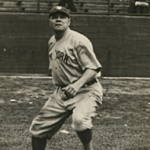
He ran for the ball, knocking head-first into a concrete wall in a game versus the Washington Senators at Washington’s Griffith Stadium. He then lay on the ground, unconscious, for five minutes. Eventually, he arose, shook off the trauma and returned to play.
Such a story as the one above seems unfathomable in current athletics. Now, if a player is hit on the head and falls unconscious, he would never be permitted to return to play immediately and, most likely, would be taken to the hospital for neurological testing. However, this is what happened to America’s famed baseball player for the New York Yankees, Babe Ruth, in 1924.
Compared to many other sports, baseball does not have a high concussion rate. Between ten to twenty players are put on the disabled list yearly because of concussions. However, even one concussion is one too many. Most prone to concussions are outfielders and catchers.
Recently, this was brought to my attention because of the story, Ex-Met Josh Satin explains why retiring is ‘the right thing’ after suffering head injuries. Specifically, while playing for the Louisville Bats, the Triple-A affiliate of the Cincinnati Reds, Satin collided with his team’s third baseman, as both were going for a pop fly. After being unconscious for five long seconds, Satin says he had a “weird feeling” and later was “never the same”. He further stated that his depth perception, once his best skill, never fully recovered. “The ball was always in a different spot than I thought.” (Officially diagnosed with post-traumatic stress disorder (PTSD), Satin sat out most of last season.)
Similarly, in December 2012, Toronto Blue Jays’ utility player Ryan Freel, the first pro-baseball player diagnosed with chronic traumatic encephalopathy (CTE) who had to retire from playing the sport because of his injuries, committed suicide. In 2013, Freel’s family donated some of his brain tissue to Boston University for study. Though Freel’s behavior after his accident pointed towards CTE, he was not officially diagnosed until this postmortem study.
Dr. Robert Stern, co-founder of the Center of Traumatic Encephalopathy at Boston University, said, “I cringe [whenever] I see two guys going after the same ball.” The MLB has said, “[it] will remain proactive on concussion and head injuries.” Home plate collisions are no longer allowed and, in 2013, the MLB said it was instituting educational programs and rule changes to protect from concussions. The prior year, the MLB mandated that any player who suffers a concussion must be put on the “disabled list” for at least 7 days.
This year, Major League Baseball established a lobbying office in the District of Columbia. Lobbying is not new for the MLB, as they have always spent time and money lobbying, most notably in the 1998 – 1999 seasons when they spent $1.6 million on it. (In comparison, last year the MLB spent about $320,000 lobbying.) The office is run by Josh Alkin, a lawyer who, before the appointment as Vice President of Government Relations in this office, had been handling issues relating to the MLB for 15 years at the firm BakerHostetler. In 2013, the MLB also stated that it aims, “to remain proactive on concussions and head injuries.”
I don’t think there is a way to entirely eliminate concussions from baseball but the MLB has instituted mandatory educational programs and certain changes to the rules to minimize these injuries. It is a good sign that the MLB, as of this year, has a lobbying office in the country’s capital to address a wide range of key government-facing issues including player safety. With these steps, the MLB hopes to eliminate some concussions, but still keep the excitement of watching a game of America’s pastime.