“Hearing” Concussions

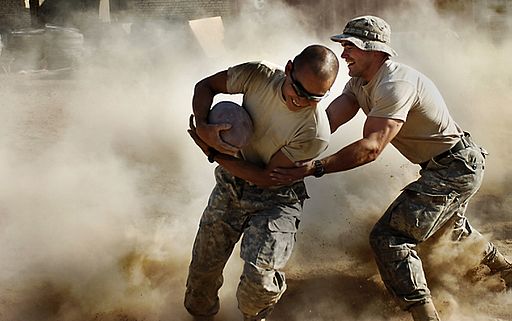
Though they are quite different on the surface, soldiers and college athletes both function in roles that can result in physical injury.  Unfortunately, this commonality means that both soldiers and college athletes have a higher likelihood of getting a mild traumatic brain injury (mTBI), also known as a concussion.  Because of this, the U.S. Army Medical Materiel Agency (USAMMA) and the National Collegiate Athletic Association (NCAA) joined forces in a search to find a better way of detecting mTBI, which may not be immediately recognizable.  The project, known as the “Grand Alliance”, is being conducted at the Massachusetts Institute of Technology’s government-funded Lincoln Laboratory (MIT LL), with the goal of creating “a U.S. Food and Drug Administration-cleared, real-time mild TBI screening app and hardware device which can be used throughout the echelons of care from point of injury to rehabilitation,” said Brian Dacanay, USAMMA product manager.  Essentially, they are in the process of creating “a computer algorithm to identify vocal biomarkers” to be used on a portable smartphone-size device that could help identify when someone needs medical help for a concussion.  MIT LL hopes to have the device ready for FDA approval by 2018.

Former Soccer Star Races Towards Congressional TBI Goal

There is a reason soccer is called football in other nations.  Much like American football, soccer requires getting the ball into a goal and preventing the other team from doing the same.  Such action requires exceptional offense and defense, which often includes certain violent maneuvers that are allowed under sports rules.

Briana Scurry, a two-time Olympic gold medalist in women’s soccer and a World Cup winner, knows this all too well.  In 2010, as the goalkeeper of the Washington Freedom, she “took the knee of a Philadelphia Independence forward to her temple at full velocity during a Women’s Professional match.”  The injury changed her life and ended her soccer career.  However, it also created a new career plan for her – advocate for brain health, particularly women’s brain health.

In 2015, U.S. Soccer banned heading in soccer for children under 10 and limited heading for children 11 to 13.  (Ages when children’s brains are still developing.) This was much needed because, as the Institute of Medicine and the National Research Council has confirmed, “young athletes in particular face a ‘culture of resistance’ when it comes to reporting and treating concussions”.  (Scurry also supports mandating that players wear headgear when they play.)  This action was partially brought to their attention by Scurry because, rightly so, “She sees herself as an advocate for women’s health, especially in relation to concussions and traumatic brain injury.

This past week, Scurry, with Joanne Finegan, Alison Cernich, Yelena Goldin, Mike Colson and Rosemarie Scolaro Moser, all whom are traumatic brain injury advocates, and joined by Rep. Bill Pascrell (NJ), the head of the Congressional Brain Injury Task Force, spoke at the “Women and Traumatic Brain Injury: A Frontier Yet To Be Explored” conference at the Rayburn House Office Building in Washington D.C.  (Scurry also testified before Congress on the same issue in 2014.)  At this conference, Scurry told her story, including her accident, recovery and her ongoing struggles.  “Scurry hopes that her testimony… will help members of Congress understand the dangers and resulting issues of brain injuries… [and] take charge in making moves to change the way things… are conducted.”  This includes changing the knowledge of doctors who once told her things like, “You can’t possibly have post-concussive syndrome anymore because it’s been too long.”  Obviously these doctors were wrong, because they were uneducated about brain injuries.

Hopefully, her testimony will help educate doctors and the public about what a concussion can do to your brain.

Statistical note:

According to the NCAA, in soccer, females are at a 2.1 times greater risk of getting a concussion than males and later have more concussion symptoms, including, but not limited to, poor concentration and increased fatigue.  (More information and statistics can be found in the online NCAA article Do Female Athletes Concuss Differently than Males?)

Ali’s Fight Continues On

This past week, Muhammad Ali lost his long struggle with Parkinson’s Disease*, but the memory of Ali is still very much in the minds of our politicians.  On May 26, Rep. Mullin (R-OK), a former professional mixed martial arts fighter, introduced H.R. 5365, the Muhammad Ali Expansion Act.  The proposed amendment expands the Muhammad Ali Boxing Reform Act of 2000, so that it applies to all combat sports.  This past Tuesday, “Rep. G. K. Butterfield (D-N.C.), the chairman of the Congressional Black Caucus (CBC), introduced a measure to recognize the “extraordinary life, accomplishments, and countless contributions” of Ali.

In his lifetime, Ali, a Muslim who changed his name from Cassius Clay when he converted to the Islam religion, was both an athlete and a political activist.  In addition to his well-known objections to war, he was a fierce advocate for civil rights.  (In remembrance of Ali, Senator Rand Paul of Kentucky plans to introduce the Muhammad Ali Voluntary Service Act, to replace the Selective Service, which Sen. Paul states, “… has a racial justice disparity.”)  In the years after his diagnosis, he became a fierce advocate and active fundraiser for Parkinson’s research, particularly for the Muhammad Ali Parkinson Center in Phoenix’s Barrow Neurological Institute .

Ali, who in 2005 received the Medal of Freedom from then President George W. Bush, would have liked the proposed legislations.  Unfortunately, we no longer have him here to advocate it.

*For the last 32 years of his life, Ali had the neurological disease, Parkinson’s.  According to a Harvard Medical School neurologically professor, who met with Ali, “People who lose consciousness through head trauma are at 50% higher risk of Parkinson’s.”  Severe, ongoing head trauma, which is a consequence of heavyweight professional boxing, can cause the development of ‘Parkinson’s proteins’ or further the development of existing, inactive ‘Parkinson’s proteins’.

(June 10, 2016, Ali was laid to rest, at a funeral in his hometown of Louisville, KY.)

Football: The Government Gets Into The Game

This past year, special attention has been given to the link between football and brain injury, particularly in the NFL.  For good reason, this past season, the incidences of concussion in the NFL rose by 58% – from 182 to 271.

The National Institute of Health, in association with Boston University, studied the brains of 91 deceased NFL players, finding that 96% of them had some form of brain injury – a stunning number, but not surprising from a sport that is rife with head-to-head defensive collisions.

Naturally, “The NFL rejects the allegations,” said NFL spokesman Brian McCarthy.  In fact, the NFL initially offered to donate $30 million to fund this study – perhaps to surreptitiously sway the findings.  However, when they found that Robert Stern, Boston University researcher and an expert on the link between football and TBI, was leading the study, the NFL dropped its promised donation.

What I do not understand is how the NFL can deny the magnitude and relevance of these statistics, especially in a study of now deceased players.  They also say that Mr. Stern was biased.  Personally, I do not understand how the NFL can claim someone can be biased on a study that relies on statistics.  Furthermore, Mr. Stern may have personal feelings about the link between brain trauma and football, but I do not believe, as an expert in the field, he would sacrifice accuracy for point of view.

Lastly, I do not think that there is a person in this country who, if asked, does not have an opinion on football and its potentially negative effects.